
We’ve Made It to Modern Day Leadership Theories
In Pt.2 we went through the classical leadership styles and discussed the concept of both transactional and transformative styles being needed in an organization to be an effective manager, leader, boss, or supreme facilitator.
Effective leadership necessitates diversity in style and flexibility of response options.
As we look at modern leadership theories, understand that leadership studies has morphed from defining one leader in totality to dissecting the styles they use and the contexts they use them in.
Allegorically, we’re not defining the plumber. We’re defining the tools they use, the ways they use them, and the jobs in which the tools are useful. In this way, picking one of these styles and embodying it alone as the sole guiding light for your future actions is about as useful as trying to solve all problems with just a hammer.
In this final research-based installment, we’re going to review the current landscape of the top five prevalent leadership styles.
As always, I did way more research and writing than I needed to. And therefore I’m front loading the good stuff and am including all leadership styles up to this point as well. Feel free to save this post as a handy guide because I have painstakingly matched each leadership style known to me to its seminal primary source.
Let’s get to it.
The Big 5 Styles
1. Adaptive Leadership (Heifetz, 1994)
Adaptive leadership was introduced in 1994 in a book called Leadership Without an Easy Answer from Ronald Heifetz. Ronald was at Harvard’s Kennedy School of Government working in the public leadership space and he noticed that many leaders were trying to solve problems with authority and expertise when the real work required people to change their values, behaviors, and expectations.
Some problems can’t be solved by leaders, only by helping people change.

(Source: Ronald Heifetz, 2021)
Ronald argues that it comes down to helping people survive and overcome the complexities of reality when reality refuses to cooperate. Adaptive leadership starts by asserting a distinction:
there are technical challenges and there is everything else.
Technical challenges have binary and numbers-based answers. If we spend $X or work on it for Y-hours, or we call up Craig, then the problem is solved. (Everyone needs a Craig, they make the world go around.)
The “everything else” problems, Adaptive problems, don’t have a straightforward solution easily solved through money, time, or the knowledge of a technical expert. The underlying problem is unclear, there is no ready solution, and people themselves have to change in order to get a win.
Technical Problems
- “The server is down.” —> Call Craig from IT.
- “Our manufacturing line has a bottleneck”
- “We need to change our process to meet a regulatory requirement”
- “We need to develop a vaccine”
- “The Espresso Machine is broken”
Adaptive Problems
- There are silos between our teams.
- Global Warming and Climate Science.
- AI adoption and automation.
- Remote/Hybrid Work.
- Low Psychological Safety.
- Burnout Culture.
Observe again that all technical problems can be solved by consulting a technical expert and throwing time and money at the problem. For Adaptive problems, the solution is abstract and multifaceted and we often lack the skills to address these problems. (Shout out Kestryl Edge LLC, this is the entire reason we exist).

(Source: The Heffelfinger Company, 2021)
We know there are silos, and we agree collaboration is good. But no one will change behavior without incentives to be less territorial and by increasing cross-team trust. We know the science of global warming. Last winter sucked. This summer we’re going to be huffing smoke and watching our forests turn to ash.
- How do we change population habits, economies that are unfavorable to renewables, public values, and political will?
- How do you get people to adopt AI?
- How do we build trust and communication plus accountability norms to support remote work?
- How do we increase psychological safety and reduce burnout? (I have entire articles on this by the way, this is a semi-rhetorical question).
Ergo Adaptive Leadership.
We mobilize people to face difficult, changing problems that do not have a clear technical fix. We use it when the challenge requires learning, behavior change, conflict navigation, or helping people adjust to new realities rather than just applying existing expertise. It is especially useful for uncertainty, institutional change, competing stakeholder demands, and situations where the old playbook has started smoking and smoldering in our hands.

(Ronald, 1998 in Mobilizing Adaptive Work: Beyond Visionary Leadership)
Adaptive Leadership is the most relevant overall because modern life keeps handing people problems with no clean manual: disruption, ambiguity, shifting roles, and unstable conditions.
We are leading through turbulence.
Adaptive leadership is how we solve the big sticky problems. It is and will be how we innovate past our preconceived notions to disrupt the status quo. Adaptive is fun. It’s abstract, philosophical, and about evolving teams beyond what they are into something new that’s capable of solving the previously impossible.
Curious on how to implement Adaptive Leadership and to learn more? I have two options for you:
- Subscribe and you’ll be the first to know when my guide comes out.
- Do what I’m doing and go read all the primary sources and scientific literature.
The research is going to happen either way. But why do your own homework when I can do it for you? That wouldn’t be a smart use of your time. Just subscribe and go do something else that’s productive. You’re a leader. It’s called delegation. Delegate for once. Trust me. I got this. If you subscribe I’ll deliver the post right to your inbox. You literally cannot mess this up.
I believe in you.
2. Inclusive Leadership
In the 1980s and 90s, organizations began formally grappling with workforce diversity through compliance-driven diversity programs. The conversation was largely focused on “Managing Diversity” and the goal outcomes were often optics-based and performative. Diversity was about who is present. Not, who is influencing decisions.
The early 2000s strike different chords as research draws a distinction between diversity (composition) and inclusion (experience). Edmondson’s 1999 work on psychological safety enters the scene and establishes that people contribute more when they feel safe.

(Amy Edmondson. Source: The Nordic Business Form 2022)
Over the next decade, conversations evolve from
“Do we have diverse people?” to “Do all people participate and matter?”
Inclusion becomes a distinct concept and is strongly linked to voice, safety, and engagement. 2010 is where I date the foundation of Inclusive leadership with Carmeli, Reiter-Palmon, and Ziv’s work which asserts that leaders who are open, accessible, and available increase psychological safety, which increases creativity. Through this lens, inclusivity becomes a leadership behavior, not just an organizational goal.
Inclusive leadership is the ability to design conditions where different voices show up, speak up, and matter. Inclusive leadership is about gardening an environment where people feel valued, safe to contribute, and able to influence outcomes.
Modern teams are more diverse across background, identity, expertise, geography, and communication style than ever. Inclusive leadership matters because the ability to create belonging, psychological safety, and real participation is now central to whether groups function at all.

(Source: Bart Reijven, 2020)
Here’s some examples to break it down.
Non-inclusive version:
- 2 senior people dominate
- Others nod, say little
- Decision is fast but shallow
Inclusive version:
- Leader pauses and asks quieter members for input
- Someone raises a concern that changes the direction
- Discussion is messier but outcome is stronger
Same team. Different leadership. And an entirely different result.
Inclusive leadership booms through the 10s and into the 2020s and it becomes a central force for Diversity, Equity, and Inclusion initiatives, innovation and team performance, and global cross-cultural leadership.
A modern example would be Deloitte’s 6 Cs model of inclusive leadership:
- Commitment
- Courage
- Cognizance of bias
- Curiosity
- Cultural intelligence
- Collaboration

(Source: Deloitte University Press, 2019)
Inclusive leadership is extremely relevant because the growing problem that people are physically in the room but psychologically absent. Inclusive leadership is all about making sure the intelligence in the room actually gets into the room.
Hey, you haven’t spoken up yet this article!
What do you think about Inclusive leadership? Whether you subscribe, drop in occasionally, or just explore what’s here, I’m glad you’re here. Subscribing is one way to stay in the loop, but engage in whatever way works best for you.
3. Coaching Leadership
Before the “coaching leadership” style formally existed, the core ideas were already alive in psychology.
- Carl Rogers (1951), person-centered therapy.
- Carl emphasized listening, empathy, and helping people find their own answers.
- Adult learning theory (Knowles, 1970s).
- Knowles asserts adults learn best when they are self-directed, not instructed.
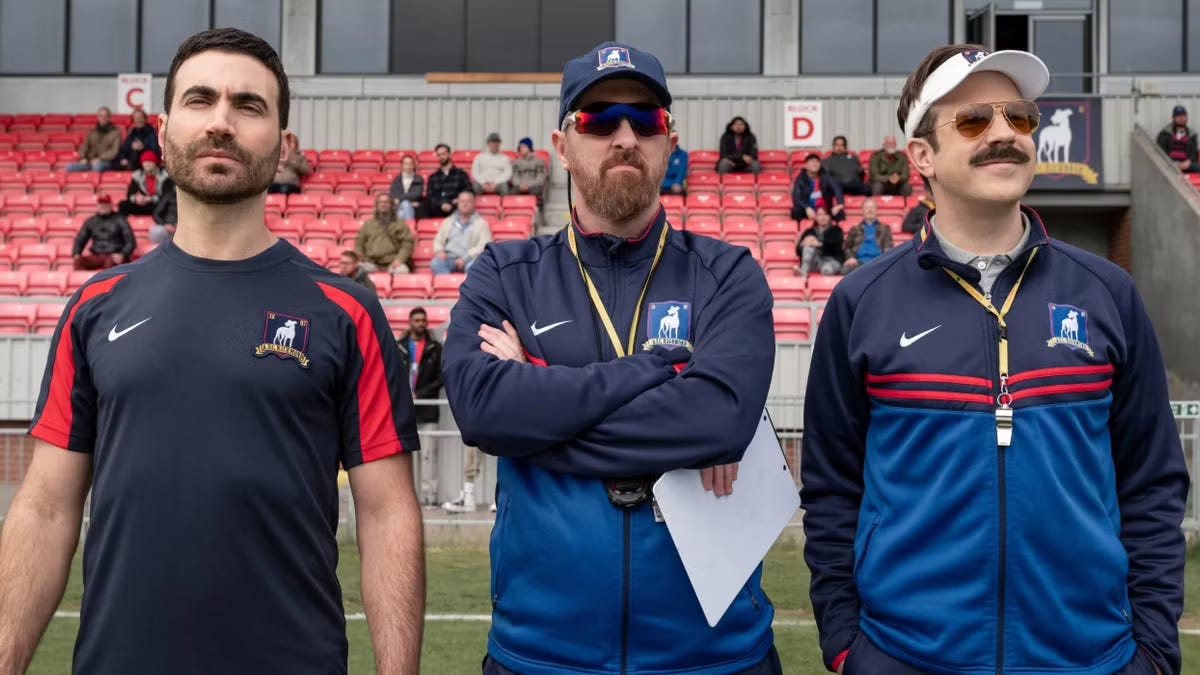
(Source: Ted Lasso, Apple TV 2023)
You ever known someone who has addictive tendencies or makes chronic poor relationship choices? (besides me – pick someone other than me)
Psychology, of course, has explanations for this.
Researchers in the early 70s converged on the knowledge that people don’t grow because they’re told what to do. They grow when they reflect, explore, and take ownership. And reflecting, exploring, and taking ownership is not an inherently fun thing to do! So we usually don’t. This is why our best friend’s last three ex’s are all mentally unstable and have intoxicating and harmful behaviors.
These adult learning and development theories developing were not directly about leadership, yet. This changes in the late 70s and early 80s as “coaching” enters the world of performance and personal development.
One of the biggest sources here is Timothy Gallwey (1974), The Inner Game of Tennis. Tim argues that performance is limited more by internal interference than lack of instruction and coaching unlocks potential, it doesn’t give answers.
Huge shift here folks – lock-in with me- : coaching is about helping people think, not telling them what to do. 🤯
- Whitmore’s (1992), Coaching for Performance popularized coaching in business and introduced the GROW model (Goal, Reality, Options, Will).
- Ellinger and Bostrom (1999) studied managers as coaches in learning organizations and identified behaviors like asking questions, facilitating learning, and encouraging reflection.
- Ellinger, Ellinger, and Keller (2003) connected coaching behaviors to performance outcomes.
- Emotional Intelligence (Goleman, 2000) identified the “coaching style” as one of six leadership styles.
From these works, leadership development programs start emphasizing feedback, mentoring, and developmental conversations.

(Source: Athena Training and Consulting Inc. 2021)
Today, coaching leadership is everywhere, especially in knowledge work areas where the main tool isn’t hands or PCs, it’s the brain.
- Factory work —> you produce physical goods
- Knowledge work —> you produce ideas, decisions, solutions, insights
- Tech and digital innovation environments
- Hands-on research and development of physical products
AI bulls will say Knowledge work is disappearing due to the rise of AI.
I say… maybe! We’ll see, won’t we? If that’s true then the demand for emotionally intelligent leaders who can coach the people running the AIs will grow. AI bears still draw the conclusion that AI is overvalued since most people are getting AI value at a steep discount due to the entire industry being funded by venture capital not revenue. Anyways, back to coaching leadership…
A lot of people no longer respond well to command-and-control leadership, especially in knowledge work. Talent development, succession planning, and any environment where people need to become stronger thinkers demands lending autonomy and room to develop critical thinking. Coaching people up is not about growing better rule-followers.

(Source: Julia Vastrik, LinkedIn 2025)
Curious on how to adopt a coaching leadership style?
Man! – I’m really proud of you for being curious.
As your coach let’s define the goal outcome. You need:
- actionable leadership advice towards building leadership skills
- accessible roadmaps for building emotional intelligence
- all tools and dialogue to be science-based with primary source references
Can you think of anyone who is generating this content and has a demonstrated track record of posting this kind of content every week?
If you identified this person do you think there is a way you could get notified once the next high-value article gets released?
Hmmmm…. 🤔
Send me a message if you need support or resources solving this puzzle. I’m here to help.
4. Digital / Virtual Leadership
E-Leadership was coined in 2002 by Avolio & Kahai as
“leadership mediated by information technology, where influence happens through digital channels rather than face-to-face interaction.”
It’s important to note here that leadership didn’t change but the medium of influence did.

(Source: Ideas.Ted.Com, 2020)
And along with the medium of influence brings questions about operating in a new digital frontier!
- How do we build trust without a physical presence?
- How does communication richness affect leadership?
- Can technology substitute for leadership behaviors?
- What kinds of leadership actions work when teams aren’t co-located?
These questions smolder and develop around the phenomenon of virtual teaming.
Most of us in-person scrubs (that’s me btw) were oblivious to the remote world and the gains it made during the 21st century leading up to our mass indoctrination in 2019.
The COVID-19 pandemic was gas lovingly and indiscriminately poured on the fires of digital leadership studies.
From the bonfire we got the following nuggets of knowledge:
Communication is architecture.
- Good digital leaders have clear written expectations, documented decisions, and intentional meeting structures.
Micromanagement becomes harder.
- Trust replaces visibility. You can’t see productivity anymore. You have to focus on outcomes. Autonomy is given by default.
- As an aside, I had a friend working in the space sector whose boss made him and his team all constantly screen share their monitors while on shift.🤢🤮
Asynchronous thinking.
- The best digital teams don’t depend on real-time at all. Strong digital leaders write clearly enough that meetings aren’t needed. Timezones and deep work are respected. Asynchronicity reduces “meeting gravity.”
Culture must be engineered.
- In physical spaces culture spreads by osmosis. Online, it isn’t there until you build it intentionally. We use rituals (weekly demos), tone (how people write, do feedback, etc.), and psychological safety in text, not just voice.
Tech fluency.
- Choosing the right tools, avoiding software bloat and redundancy, and understanding how tools shape behavior.
A dominant share of modern leadership now happens through screens, platforms, chat, email, dashboards, and remote or hybrid coordination.

(Source: Indeed, 2021)
This matters because leading without physical presence is no longer a niche problem, it is a standard operating norm.
Digital Leadership is very interesting to me because all of a sudden, where we’re from, what we look like, and how we come-off all becomes secondary to our output. Code switching is less necessary in virtual settings. we have more time to emotionally regulate because there are built-in pauses in digital communication that aren’t there face-to-face. Remote work can be a force for equality and more emotionally intelligent outcomes as teams move to virtual platforms.

(Source: Rishabh Bhandari, Kapable 2026)
In the digital age, you need clear instructions and actionable knowledge synthesized by human sources you can trust.
If you’re finding my articles valuable, subscribe so you can cut through the static and supercharge your leadership development.
If you think my Substack is a stinky dumpster fire and I need to stop this sad attempt at writing elevated self-help… first of all you’re a true friend for enduring my work and making it 4 examples deep into this post. You may as well just subscribe.
Second of all… I would really appreciate some honest feedback. Put it in the comments if you’re feeling brave. Shoot me a DM if you want to be constructive and courteous. Restack this article with your feedback publicly if you woke up and chose violence today.
You can’t hurt me.
Lack of feedback from such a loyal reader and friend is pretty hurtful though… Now is a great time to flex those digital leadership muscles and practice giving clear, concise feedback! Good luck.
I promise I’ll be defensive and reactive at first. Then, I’ll admit you’re right and implement the feedback accordingly. If I had a moment of weakness and lashed out to protect my ego you can also expect a heartfelt and timely apology preceding my summary of how I implemented your feedback.
It’s called digital leadership, look it up.
5. Authentic Leadership
Authentic leadership is simultaneously one of my favorites and least-favorites. It’s important to mention in this big 5 because it’s everywhere. And many people get it wrong and misrepresent authentic leadership making it sound really sexy and overly effective. Like one simple pill that gives you a tone booty and an instant 6-pack. No crunches or Bulgarian split-squats required.
6-pack abs and authentic leadership are the same in that you can’t magically shortcut the hard work and discipline. The self work required to achieve authentic leadership (yes it happens to you) is a long term endeavor of learning yourself. For me, this happened over 6 years of near-weekly counseling and therapy. It may happen faster for others.
What I’m getting at, perhaps circuitously, is that we, the people who care about leadership studies and the growth of leaders in the world, need to have an honest conversation about how we portray authentic leadership and its benefits in life and the workplace.
Let’s zoom out for a minute.
By the late 20th century, leadership research had become a tad mechanical: traits, behaviors, and contingencies.
All of these were useful, but emotionally thin. At the same time, we saw major corporate scandals and had broad loss of trust in major institutions.
We still have this today in many ways. It never left just changed forms over the years.
Bigger Company (think ~Comcast, Black Rock, Palantir~) = Less Trust.
Ol’ mom and pop shop (your local espresso and avocado toast dealer) = Bigly Trust.
Researchers started asking “what makes a leader real, not just effective?”
People are increasingly skeptical of polished-but-hollow authority.
Enter Bill George, 2003, who publishes a book called Authentic Leadership based on reviews with a laundry list of executives. His core claim is that great leaders are not defined by style, but by self-awareness and values-based action. He emphasized that a leader needs purpose, values, relationships, and consistency.

(Source: Sharon Gill, LinkedIn 2023)
Avolio, Luthans, and Walumbwa in the mid-2000s defined Authentic leadership as having four key components:
- Self-awareness
- Relational transparency
- Balanced processing (considering multiple viewpoints)
- Internalized moral perspective
It intersects with transformational and ethical leadership as well as positive organizational behavior, so much so that it can be hard to draw distinct lines between the theories. At its heart, authentic leadership argues that leadership is not a performance you put on; it’s a pattern of alignment between who you are, what you value, and how you act.
Some literature has strong evidence to support Authentic Leadership styles as an answer to psychological safety, burnout, and finding work meaningful. Authentic leadership still matters because people want leaders who seem real, consistent, and grounded rather than purely performative.

(Source: Avolio et.al., 2004)
We’re hyper-sensitive to people performing authenticity to grift us of our attention, time, and money.
Authenticity has been commodified and monetized to the point where it’s hard to know and find trust in those online and around us. When we find someone who comes across as authentic to us, it’s a breath of fresh air.
With that, authenticity ask us to show up and be radically transparent. Which can be dangerous and harmful for some.
My close friend identifies as queer and is atheist due to being subjugated to a religious cult as a kid. She attends university to become a teacher and her cohort is deeply Catholic. There is nothing inherently wrong with being religious, by the way.
During group discussions, it has been claimed by self proclaimed students that “teachers shouldn’t talk about their gay relationships in front of kids” and “being gay is wrong and shouldn’t be acknowledged in schools because it is against the lord and not in line with proper values.”
As a staunch and outspoken advocate for the rights of all people, my friend tried to speak out against her cohort but was picked on and alienated by the class. Authenticity is easy to say and easy to type.

(Source, Istock photos, 2026)
And I respectfully call bullshit.
Being radically transparent only works when [who you really are] is already in line with the local dominant leadership archetypes.
- e.g. My friend can be authentic in a group of like-minded and accepting colleagues.
- e.g. It is socially punishing to be authentic in a classroom with people of different beliefs who use those beliefs to extrapolate what is and is not okay for others.

(Source, @midtownunifom, 2022)
Radical Authentic leadership supporters tell us that by being ourselves we’re morally better-than. It inflates our sense of justice and perceived right-ness. That by merely calling ourselves authentic and saying “I embrace my true self” you become a leader worth admiring. That you instantly become a leader worth following who is helpful through sheer virtue of being yourself. This is borderline narcissistic and deeply wrong.
Think about the charismatic cult leader. Authenticity is great until we weaponize it for the benefit of organizational goals and capitalistic objectives.
I find authentic leadership interesting because at its core its asking for self-acknowledgement self-regulation and development of a balanced perspective.
I believe real authentic leadership is very punk rock.
- It’s knowing what’s right. It’s doing the right thing even when the right thing is unpopular. It’s standing up to bullies. It’s dissenting in a board room of people older than you.
We all could regulate more, consider multiple viewpoints, and find ways of being empathetically transparent. And, through this self-work we will no doubt be more useful and ready to serve. Think critically while reading notes on Substack like “alignment is clarity” and “embrace your true self and never lose clarity again.”
So, Authentic leadership makes the top 5 for three reasons:
- It has gained considerable popularity and is supported by a growing body of empirical research; however, its evidentiary base is arguably overstated. For my finance bros, it’s trading at a premium, in a speculative bubble, and lacking sufficient underlying support in robust empirical outcomes.
- The principles it stands for are solutions to problems we’re facing. Self-awareness is critical, transparency builds trust, and considering multiple views leads to better engagement and higher quality decisions.
- It undermines the credibility of the leadership field by conferring an unearned moral authority upon already privileged individuals.
I could go all day. To my managers and aspiring leaders out there: be weary of the organization asking you to be authentic as a tool to meet their outcomes. Authenticity is earned, not performed. And it certainly isn’t a tool to increase performance. To my new people entering the workforce: know what you care about, trust your gut, focus on helping others, and learn to set boundaries.
Key Takeaways
There are a large number of leadership theories available. All of them are interesting, and the ones we should pay the most attention to are those that help us live in the increasingly digital world, build the best teams, and solve the biggest problems. Prevalent leadership theories that are solid in principle can overextend our standing. Be aware of the theories and practices we embody and teach. In Pt.IV, I think I’ll do a review of the toolkit and share the most common scenarios one may need a leadership style and the best ones for the job.
The most important step is always the next one.
-Dan
The List
- Adaptive Leadership – Leadership mobilizing people to address complex, evolving challenges.
- Primary Source: Heifetz (1994)
- Inclusive Leadership – Leadership fostering belonging, openness, and psychological safety.
- Primary Source: Carmeli, Reiter-Palmon, and Ziv (2010)
- Coaching Leadership – Leadership focused on development through feedback, inquiry, and facilitation.
- Primary Source: Ellinger and Bostrom (1999)
- Digital / Virtual Leadership – Leadership exercised through advanced information technology rather than relying mainly on in-person presence.
- Primary Source: Avolio, Kahai, and Dodge (2000)
- Authentic Leadership – Leadership grounded in self-awareness, transparency, and values-based action.
- Primary Source: Avolio and Gardner (2005)
- Trait Leadership – Leadership is viewed as the product of stable personal qualities and inherited traits.
- Primary Source: Galton (1869)
- Behavioral Leadership – Leadership defined by observable patterns of task and relationship behaviors.
- Primary Source: Stogdill and Coons (1957)
- Autocratic Leadership – Centralized decision-making with top-down control by the leader.
- Primary Source: Lewin, Lippitt, and White (1939)
- Democratic / Participative Leadership – Leadership involving group members in discussion and decision-making.
- Primary Source: Lewin, Lippitt, and White (1939)
- Laissez-faire Leadership – Leadership minimizing direct control and granting high autonomy to followers.
- Primary Source: Lewin, Lippitt, and White (1939)
- Contingency Leadership – Leadership effectiveness depends on the fit between a leader’s style and situational conditions.
- Primary Source: Fiedler (1967)
- Transactional Leadership – Leadership based on exchanges, rewards, and role-based performance.
- Primary Source: Burns (1978)
- Charismatic Leadership – Leadership driven by symbolic influence, vision, and follower devotion.
- Primary Source: House (1976)
- Transformational Leadership – Leadership that elevates values, motivation, and commitment beyond simple exchange.
- Primary Source: Bass (1985)
- Leader–Member Exchange (LMX) – Leadership as differentiated dyadic relationships between a leader and individual followers.
- Primary Source: Dansereau, Graen, and Haga (1975)
- Contextual Leadership – Leadership is shaped by the specific situational, organizational, and environmental context.
- Primary Source: Oc (2018)
- Servant Leadership – Leadership prioritizing follower growth, well-being, and service over personal control.
- Primary Source: Greenleaf (1970)
- Shared Leadership – Leadership distributed across team members rather than centralized in one person.
- Primary Source: Pearce and Conger (2003)
- Empowering Leadership – Leadership granting autonomy, discretion, and confidence to followers.
- Primary Source: Arnold et al. (2000)
- Strategic Leadership – Leadership focused on long-term direction and top-level organizational decisions.
- Primary Source: Hambrick and Mason (1984)
- Crisis Leadership – Leadership involving sense-making and rapid decision-making under high-pressure conditions.
- Primary Source: Boin et al. (2005)
- Humble Leadership – Leadership emphasizing openness, teachability, and the recognition of personal limits.
- Primary Source: Owens and Hekman (2012)
- Complexity Leadership – Leadership enabling adaptive, emergent dynamics within complex systems.
- Primary Source: Uhl-Bien, Marion, and McKelvey (2007)
- Identity-Based Leadership – Leadership focused on building and advancing a shared social identity.
- Primary Source: Haslam, Reicher, and Platow (2011)
References
Arnold, Josh A., Sharon Arad, Jonathan A. Rhoades, and Fritz Drasgow. 2000. “The Empowering Leadership Questionnaire: The Construction and Validation of a New Scale for Measuring Leader Behaviors.” Journal of Organizational Behavior 21 (3): 249–69.
Avery, Gayle C., and Harald Bergsteiner. 2011. Sustainable Leadership: Honeybee and Locust Approaches. New York: Routledge.
Avolio, Bruce J., and William L. Gardner. 2005. “Authentic Leadership Development: Getting to the Root of Positive Forms of Leadership.” The Leadership Quarterly 16 (3): 315–38.
Avolio, Bruce J., Surinder Kahai, and George E. Dodge. 2000. “E-Leadership: Implications for Theory, Research, and Practice.” The Leadership Quarterly 11 (4): 615–68.
Bass, Bernard M. 1985. Leadership and Performance Beyond Expectations. New York: Free Press.
Boin, Arjen, Paul ’t Hart, Eric Stern, and Bengt Sundelius. 2005. The Politics of Crisis Management: Public Leadership Under Pressure. Cambridge: Cambridge University Press.
Boyatzis, Richard, and Annie McKee. 2005. Resonant Leadership: Renewing Yourself and Connecting with Others Through Mindfulness, Hope, and Compassion. Boston: Harvard Business School Press.
Brown, Michael E., Linda K. Treviño, and David A. Harrison. 2005. “Ethical Leadership: A Social Learning Perspective for Construct Development and Testing.” Organizational Behavior and Human Decision Processes 97 (2): 117–34.
Burns, James MacGregor. 1978. Leadership. New York: Harper & Row.
Carmeli, Abraham, Roni Reiter-Palmon, and Enbal Ziv. 2010. “Inclusive Leadership and Employee Involvement in Creative Tasks in the Workplace: The Mediating Role of Psychological Safety.” Creativity Research Journal 22 (3): 250–60.
Choi, Yeon, and Rae R. Mai-Dalton. 1998. “On the Leadership Function of Self-Sacrifice.” The Leadership Quarterly 9 (4): 475–501.
Conger, Jay A., and Rabindra N. Kanungo. 1987. “Toward a Behavioral Theory of Charismatic Leadership in Organizational Settings.” Academy of Management Review 12 (4): 637–47.
Dansereau, Fred, George Graen, and William J. Haga. 1975. “A Vertical Dyad Linkage Approach to Leadership within Formal Organizations: A Longitudinal Investigation of the Role Making Process.” Organizational Behavior and Human Performance 13 (1): 46–78.
Day, David V. 2000. “Leadership Development: A Review in Context.” The Leadership Quarterly 11 (4): 581–613.
Downton, James V., Jr. 1973. Rebel Leadership: Commitment and Charisma in the Revolutionary Process. New York: Free Press.
Einarsen, Ståle, Merethe Schanke Aasland, and Anders Skogstad. 2007. “Destructive Leadership Behaviour: A Definition and Conceptual Model.” The Leadership Quarterly 18 (3): 207–16.
Ellinger, Andrea D., and Robert P. Bostrom. 1999. “Managerial Coaching Behaviors in Learning Organizations.” Journal of Management Development 18 (9): 752–71.
Ernst, Chris, and Donna Chrobot-Mason. 2011. Boundary Spanning Leadership: Six Practices for Solving Problems, Driving Innovation, and Transforming Organizations. New York: McGraw-Hill.
Fiedler, Fred E. 1967. A Theory of Leadership Effectiveness. New York: McGraw-Hill.
Galton, Francis. 1869. Hereditary Genius: An Inquiry into Its Laws and Consequences. London: Macmillan.
Greenleaf, Robert K. 1970. The Servant as Leader. Cambridge, MA: Center for Applied Studies.
Hambrick, Donald C., and Phyllis A. Mason. 1984. “Upper Echelons: The Organization as a Reflection of Its Top Managers.” Academy of Management Review 9 (2): 193–206.
Haslam, S. Alexander, Stephen D. Reicher, and Michael J. Platow. 2011. The New Psychology of Leadership: Identity, Influence and Power. New York: Psychology Press.
Heifetz, Ronald A. 1994. Leadership Without Easy Answers. Cambridge, MA: Harvard University Press.
Hogg, Michael A. 2001. “A Social Identity Theory of Leadership.” Personality and Social Psychology Review 5 (3): 184–200.
House, Robert J. 1976. A 1976 Theory of Charismatic Leadership. Toronto: University of Toronto, Faculty of Management Studies.
House, Robert J., Paul J. Hanges, Mansour Javidan, Peter W. Dorfman, and Vipin Gupta, eds. 2004. Culture, Leadership, and Organizations: The GLOBE Study of 62 Societies. Thousand Oaks, CA: Sage.
Joiner, Bill, and Stephen Josephs. 2007. Leadership Agility: Five Levels of Mastery for Anticipating and Initiating Change. San Francisco: Jossey-Bass.
Lewin, Kurt, Ronald Lippitt, and Ralph K. White. 1939. “Patterns of Aggressive Behavior in Experimentally Created ‘Social Climates.’” Journal of Social Psychology 10 (2): 269–99.
Lord, Robert G., Roseanne J. Foti, and Christy L. De Vader. 1984. “A Test of Leadership Categorization Theory: Internal Structure, Information Processing, and Leadership Perceptions.” Organizational Behavior and Human Performance 34 (3): 343–78.
Maak, Thomas, and Nicola M. Pless. 2006. “Responsible Leadership in a Stakeholder Society: A Relational Perspective.” Journal of Business Ethics 66 (1): 99–115.
Oc, Burak. 2018. “Contextual Leadership: A Systematic Review of How Contextual Factors Shape Leadership and Its Outcomes.” The Leadership Quarterly 29 (1): 218–35.
Owens, Bradley P., and David R. Hekman. 2012. “Modeling How to Grow: An Inductive Examination of Humble Leader Behaviors, Contingencies, and Outcomes.” Academy of Management Journal 55 (4): 787–818.
Pearce, Craig L., and Jay A. Conger, eds. 2003. Shared Leadership: Reframing the Hows and Whys of Leadership. Thousand Oaks, CA: Sage.
Selznick, Philip. 1957. Leadership in Administration: A Sociological Interpretation. Berkeley: University of California Press.
Stogdill, Ralph M., and Alvin E. Coons, eds. 1957. Leader Behavior: Its Description and Measurement. Columbus: Bureau of Business Research, Ohio State University.
Sy, Thomas. 2010. “What Do You Think of Followers? Examining the Content, Structure, and Consequences of Implicit Followership Theories.” Organizational Behavior and Human Decision Processes 113 (2): 73–84.
Uhl-Bien, Mary, Russ Marion, and Bill McKelvey. 2007. “Complexity Leadership Theory: Shifting Leadership from the Industrial Age to the Knowledge Era.” The Leadership Quarterly 18 (4): 298–318.
West, Michael A. 2021. Compassionate Leadership: Sustaining Wisdom, Humanity and Presence in Health and Social Care. Swirling Leaf Press.
Westerman, George, Didier Bonnet, and Andrew McAfee. 2014. Leading Digital: Turning Technology into Business Transformation. Boston: Harvard Business Review Press.
Zhang, Yun, David A. Waldman, Yulin Han, and Xuebing Li. 2015. “Paradoxical Leader Behaviors in People Management: Antecedents and Consequences.” Academy of Management Journal 58 (2): 538–66.
Summary
Modern leadership theory emphasizes flexible leadership styles, adaptive management, and situational leadership rather than relying on a single approach. Effective leaders balance transactional and transformational leadership while applying the right tools to the right context, recognizing that complex organizational challenges often require behavior change, innovation, and strategic problem-solving rather than simple technical fixes. Among the most relevant approaches today, adaptive leadership stands out for navigating uncertainty, organizational change, and high-stakes decision-making, while inclusive leadership drives employee engagement, psychological safety, diversity and inclusion (DEI), and team performance by ensuring all voices contribute to outcomes.
In parallel, coaching leadership supports employee development, performance management, and leadership development by fostering critical thinking and autonomy, especially in knowledge-based industries. The rise of digital and virtual leadership reflects the shift toward remote work, hybrid teams, and technology-driven communication, where trust, clarity, and asynchronous collaboration are essential. Finally, authentic leadership highlights the importance of self-awareness, emotional intelligence, and values-based leadership, though it must be applied thoughtfully to avoid performative or inequitable outcomes. Together, these top leadership styles form a modern leadership toolkit designed to improve organizational effectiveness, team collaboration, and long-term business success.