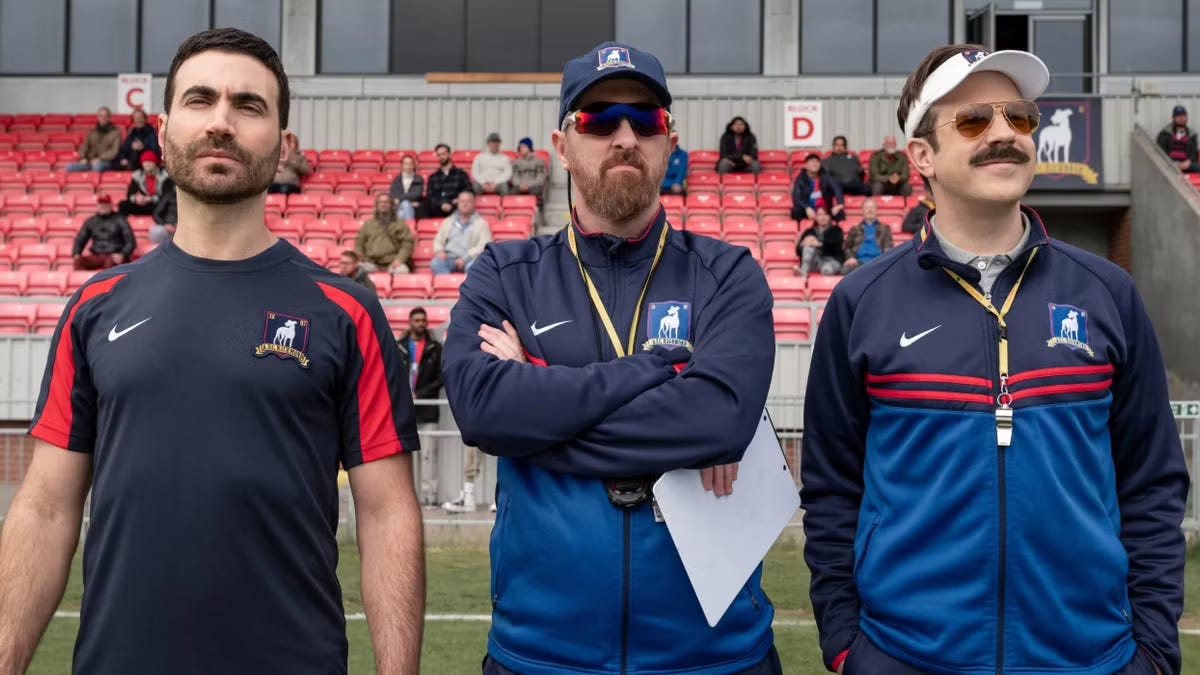
The meeting that melted some brain cells and made you wish you were in high school where if you wore a hoodie you could sneak having one ear-bud in and the teacher wouldn’t notice you jamming out to Blink-182.
Thanks for reading Daniel Korus! Subscribe for free to receive new posts and support my work.
In my day, the pro-move was to put your ear buds down your sleeve, into your palm, then lean your ear against your palm like you were tired. Maybe that’s why my neck is sore. From hours of poor posture to main line Green Day and Avril Lavigne.
The kids these days probably have AI vape pens that can telepathically broadcast Roblox K-Pop live streams to anyone in the room who owns a Labubu. (I had to pay a 7th grader $5 to help me write that sentence)
So anyways. Meetings.
How Bad is the Problem?
Your average employee has about six hours of meeting each week. For managers it’s twenty three hours on average. For senior roles, averages shoot up to 80% of total work time is spent in meetings (Mroz, 2018). For a 40-50 hours work week that’s 32- 40 hours of meetings per week.
If we classify meeting time by job-type and look at knowledge workers (remember – knowledge workers are those who’s primary tool is their brain e.g. researchers, consultants, engineers) 25%-80% of their time is spent in meetings (Romano, 2001)
How productive is our time being spent?
Studies show… Not productively at all!
Depending on where you look and how sensationalized the data is, the stats range from eye-brow raising to apocalyptic. Those same knowledge workers from the Romano study self-rated their meeting productivity as 33%-47% effective.
A study from the same year done by the Chartered Institute of Personnel and Development (CIPID) synthesized a body of research on how to run meetings productively and concluded that few execute proper meeting techniques consistently AND that effectiveness depends on top-notch structure, goals, timing, and participation.
A recent 2026 study looking at 7,196 meetings held with 361 employees found that ineffective meetings remained ineffective even when employees tried to execute better meeting hygiene practices. This reinforces notions that even if we know some good meeting practices they need to be used consistently and in concert to positively impact productivity.
The take away from all this research?
Running a good meeting is hard. Harder than we think. And we all have a high tolerance to poor-quality meetings.
These studies culminate into the apocalyptic (and in my opinion sensationalized) statistics we run into. For example MeetingTolls’ 2026 article on “Meeting Waste Statistics and Costs” which aggregates peer reviewed data sets and draws the following conclusions:
71% of meetings are unproductive
Each employee wastes, on average, 31 hours per month due to meetings
$37 billion USD is wasted in the US annually due to meetings
So back to the question “how bad is the problem?”
(Source: The Office, S2 E6, 2009)
For some- really bad.
For all of us – bad enough we should take the time to review the basics on how to lead a good meeting .
The bright side? The bar for a good meeting is low. And there is an opportunity to shift the paradigm and lead the best meetings of your organization.
Let’s be apart of the solution in our life and in our immediate circles.
How To Lead a Good Meeting
Leading a good meeting is about respecting people’s time, driving solutions, being organized, implementing an inclusive and adaptive leadership style, and making sure it’s not all about you.
As tempting as it is to turn your weekly sync into a 45 minute standup comedy routine to your captive audience, you gotta chill-out and facilitate A-Game bureaucracy to drive results. Yes, have fun, but save the knock knocks for Wednesday mini-golf.
Start From a Clear and Defined Purpose.
“We’re meeting to…”
Make a decision about X
Get alignment on Y
Brainstorm about Z
AVOID the traps of an ill-defined “Team Sync” or “Quick Huddle”.
The meeting needs to have a goal.
The goal can be recurring. And it can be to review recent work. However, a recurring meeting to generally review recent work often turns into people regurgitating everything the did in the last week regardless of if the information is useful to those in attendance. It becomes performative. As if not sharing last weeks work means you didn’t do anything. To solve this, add strict time bounds to recurring meetings and make them a standing meeting.
For example, a morning stand up to discuss the work for the day and a brief safety message. Agenda is to review the work for 3 minutes, and give a 2-minute safety message. Outcomes are we’re on the same page for the day.
Take Away – If you can’t write a very clean agenda and outcome for the meeting, you shouldn’t be doing the meeting. If you’re comfortable in your role, decline the invite. Don’t go. Vote with your time.
As I ruthlessly tell my teammates when I decline their invites
“No Agend-y no Attend-Y.”
Read on for a sample agenda below.
(Source: Gemini, 2026)
Wherever Possible, Send Context and Lore Before the Meeting.
Send lore along with your agenda.
Provide the lore – the historical context of the meeting leading up to this point.
E.g.
Purpose – We’re meeting to decide on a path forwards for a magical ring a hobbit found.
Agenda –
(2 mins) introductions
(5 mins) cross-racial meeting expectations and goal outcome summary
(20 mins) discussion of goal
(10 mins) decision to be made by Gandalf
(5 min) recap and review of action items
Lore – Bilbo found a magic ring and Gandalf identified it as world-ending asset to enemy forces. This meeting is 45 minute round table to discuss and decide on a path forward. Apologies for scheduling over lunch.
Share key data and pre-reads ahead of time.
E.g. See attached historical texts from Gandalf’s secret libraries.
Highlight the information in a document that needs discussing.
E.g. Please review risk and consequence memo sent about nefarious actors obtaining the magic ring.
Let people arrive with thoughts already thunk.
(Source, Dilbert, 2008)
For high consequence decisions especially, people should show-up knowing what we’re deciding on, why it’s important, and who owns the decision.
AVOID calling people together to do your homework or hastily read over the context.
I really enjoy a good working meeting where a team creates a document or something together but be careful that you arrive with the homework done, ready for collaboration.
No one likes going to a meeting to finish Steve’s report that he was supposed to have done already.
Another special hell is doing a meeting where all attendees are already caught-up and actively executing and the meeting is to brief the one out-of-the-loop senior leader.
PRO TIPS
If you’ve been that leader, it may be time to find better ways of staying engaged and trusting the team.
If you have that leader as a boss, it’s time to learn how to manage-up to get them the context they need ahead of time so it doesn’t affect the rest of the team during the meeting.
Design The Flow. Stick To The Flow.
Strong meetings have a structured flow:
Opening
Purposed discussion blocks
Decisions/ recaps
Here’s one I used weekly with my core team as a project manager for multi-million dollar initiatives.
(5 mins) Surface Top Issues/Blockers (top risks and blockers of forward progress)
(5-10 mins) Review Open Action Items (Either close out/recruit help/push out/or pull in)
(15 mins) Round Table Status on Critical Path Activities (identify main blockers and next steps)
(10 Mins) Open Discussion
(5 Mins) Review new Actions and close.
The follow ups are what matter. Compile all the main blockers and do something about them. Escalate, recruit help, ask for advice, delegate,…, whatever you need to do to ensure the problems are solved or you have a great reason why they can’t be solved yet.
(Source, ChatGPT, 2026)
This meeting structure allows the core working team to focus on their work and gives me their issues to go tackle them to enable further productivity.
Don’t do this meeting agenda if you have no intentions of trying to solve the problems you collect. It will erode trust fast and turn this sort of meeting into an echo chamber of frustration.
Actively Manage Participation
Pull in people who aren’t talking. Ensure no opinion is left behind.
“Okay it sounds like X… are we all okay with that?”
“It seems like we’re making a decision on Y, can we lock it in and proceed to the next topic?”
“It seems like the general consensus is X, and we have surfaced risks on Y. Z is our current path forward. Am I missing anything so far?”
Acknowledge and capture the thoughts of those who contribute. Balance dominate voices without shutting them down.
“That’s a strong point, who hasn’t spoken who wants to build off it?”
“Let’s hear from someone who hasn’t spoken yet.”
For over-sharers – in a quick 1:1 before/after the meeting with your dominant contributor – “You’ve got great ideas, and I want to make sure others get space so we can build on them. Can you help me support some of the less eager voices in the room?”
Orchestrated conversation >> open mic.
Being able to stifle domineers and brash participants is a super power. This is your meeting. If you are able to diplomatically quench rudeness and bullying, people will find your meetings a psychologically safe environment and your meeting quality will be much higher.
It’s a very hard thing to do but you’ll need to find a way to ask people to leave if they can’t abide by your ground rules.
If you’re new to a team, your first team meeting must include an activity to set ground rules together.
Capture the ground rules and send them out to everyone.
Ensure people know, these are the rules for my meetings, and if we don’t follow them, violators are not welcome.
“Hey, I think that comment wasn’t in alignment with our ground rules. Can we stick to those going forwards?”
“Woah woah woah – I think we’re getting off track here. Let’s remember our ground rules and finish strong.”
“That comment was inappropriate and didn’t align with our ground rules. Would you mind stepping out while we finish up? I’ll send you notes after.”
Take Notes and Make Them Public
Present with an open word/notes doc on the screen/projector and capture discussion points, decisions, new actions, questions, etc.
If it’s a recurring meeting just keep writing in the same document so all meeting occurrences are captured in that document. I call this a ‘meeting manifest’.
This is an amazing way to create accountability and transparency on a team. Gone are the days where one meeting you decide to do something and then the next someone challenges the past decision. Share the note file after every meeting with all attendees. Have AI write you a summary and clean up the notes. It’s really that easy.
I’ve really been loving using AI transcription tools to capture my notes for me so I can focus on the conversation without having to type. There are tons of AI tools to choose from here.
End your meeting with a recap of decisions, owners, and next steps.
Remember if nothing changed after the meeting, then the meeting didn’t do anything.
Here’s my meeting manifest template I use for recurring meetings.
MEETING TITLE
Purpose of the Meeting(s) –
Core Attendees –
Table with Open Action items
Thing needed, who owns it, when it’s due by. Sorted by relative importance and time sensitivity. (the a.i. table only has open items, close items get copied to the day entry they were closed)
All Meeting Occurrence Notes (Most recent at the top)
DATE 1
Attendees
New Actions
Actions Closed
Topics Discussed
Decisions Made
Agreements Made
Status
DATE 2…
“ ”
etc.
(Source, ChatGPT, 2026)
The meeting manifest is amazing for recurring meetings with important purpose and low accountability in the working team. This gives you a collaborative track record of what was accomplished and is a foundation for future discussions. When things are written down it’s easier to hold people to agreements.
High paced and complex environments thrive when there is detailed documentation. It’s a second brain. More on notes and organization in future posts.
Know Your Triggers
Write down the list of things that will cause you to have an emotional trigger.
Know this list and when you inevitably get triggered, pause, take some notes, drink some water, put in a mint or some gum, and only open your mouth when you’re calm and collected. The number one reason why executives get fired is lack of impulse control. So control your impulses.
Here’s my list of triggers as an example:
Locker room jokes made by loud men in a room with women (or men for that matter) who are obviously uncomfortable.
The top boss talking nonstop.
People blaming my team when they don’t know the full story.
People saying anything bad about my team, really.
Open mouth gum chewing.
The “back in my day we used to do X,Y, and Z so you need to get over it.”
Emotional and empty feedback. “I don’t like it. This sucks”
“You don’t know what you’re talking about.”
Yelling and raised voices.
Yes. I am a human too. Do any of these in my presence and I will be taking deep breaths to calm myself down. My best strategy is to write down people’s arguments with pen and paper so I can process what they’re saying and return to it once I’m calm.
My favorite calming down strategy is to just write down what the person said. Sit quiietly while I grab some water, breath, and stretch, and refuse to not have good posture. I sit tall and think.
Then after the meeting I tell them my thoughts.
“When you do this, it has this effect. And I’m setting a boundary that you can not do this around me again.”
I’ve done this multiple times in my career and never regretted it.
Just last week in fact – “When you make those jokes around the team it makes people uncomfortable. It’s unprofessional and not appropriate. Don’t make those jokes at work again. Thank you.”
Setting boundaries is a skill. Being able to stand your ground to people on their behavior is a super power.
Now that the basics are out of the way… let’s get into the advanced meeting Jutsu.
Advanced Meeting Jutsu
Jutsu (術), translates from Japanese to mean to “technique,” “method,” or “art,” and are the mystical skills and combat techniques used by shinobi (ninja) who were covert agents in feudal Japan specializing in espionage, sabotage, and infiltration.
I share these Jutsu not to sow unrest or imply that being a shady teammate is honorable. It’s not. Don’t manipulate people. Be a force for good, always.
(Source, Gemini, 2026)
I share these because people out there do this. Often. And they are good at it. And they get what they want because of it.
My philosophy is as a Defense Against the Dark Arts Professor. Doing the right thing is harder if you don’t know what you’re up against. Knowledge is power. Use this Jutsu and its defense to dismantle unethical and ill-aligned regimes.
Pre-Wire The Room
Pre-Wire is a construction analogy. Electrical wiring is routed before walls are sealed up. It’s about setting up structural alignment before finalizing.
Talk to key stakeholders 1:1 before hand.
Surface and handle objections from key stakeholders early so they aren’t a surprise later on.
Shape the narrative before you get to the meeting room.
Pre-Wiring when done right turns meetings into quick, formal conversations instead of lengthy debates. It is essentially what lobbyist do to control political outcomes in America.
It’s the Hamilton “room where it happens.”
(Source, ChatGPT, 2026)
This method adds some leg work but smooths the meeting process significantly and can prevent unforeseen volatility.
Frame the Problem Yourself to Control the Default Outcome
There’s power in the pen.
Whoever defines the question controls most of the outcome.
“What should we do?” → Chaos
“Which of these three paths best fits our constraints?” → Directional Conversation
Advanced move: subtly constrain the option set without announcing that you’re doing it.
Make sure all of your presented options work for you.
Also, people react to what’s presented.
So:
Put your preferred option as the baseline.
Frame alternatives as deviations (“If we don’t do this, then…”).
The room ends up debating adjustments based on risk logic, and your preferred direction comes off as the sane status-quo.
Use Time as a Pressure Dial
It’s the adage that “Tasks take as long as you give yourself.”
For a meeting with a target outcome:
Tight time → forces prioritization and reactionary decisions
Open time → invites exploration and creative divergence
Pair tight timing, say 15 minutes, with the above jutsu to frame your ideal path as the primary one with deviations being risky.
This can backfire if your solution is not well thought out. If you’re going to do this have something air tight.
(Source, ChatpGPT, 2026)
Manufacture Convergence
You don’t just say “we agree.” People can easily say no to that. You creativelyportray that agreement is already forming.
“I’m hearing a lot of alignment around X…”
“It seems like we’re circling the same conclusion about Y…”
Even if alignment is partial, if you state it well you crystallize it into reality. This creates sides and ‘others’ dissentious voices. You’re making people force conflict in order to disagree. The nuances are subtle. And subtlety is everything.
Redefine Resistance as Risk
Instead of:
“Some people don’t like this”
Re-frame:
“The risk we’re managing is…”
Objections have to compete on risk logic, not personal comfort.
E.g. “We’re evaluating the likelihood of this event within a given time-frame. Do we have data suggesting it’s statistically probable?”
This is a common redirect as it puts the burden of proof on the oppositional side. It’s essentially the corporate version of “prove it.”
Pull Objections Into the Light Selectively
Unspoken resistance is dangerous and timing matters.
Surface objections after momentum for your chosen outcome builds
Then address them as refinements, not deal-breakers
You want to sequence dissent.
You (after some agreement has formed):
“Sounds like we’re aligned on moving forward with Option B as the baseline.”
Colleague (hesitant):
“Yeah… I mean, I still have some concerns about the rollout timeline.”
You (welcoming, but contained):
“That’s helpful, let’s capture that. What specifically about the timeline feels tight?”
Colleague:
“I’m worried we don’t have enough buffer for testing.”
You (reframing as refinement):
“Got it. So the direction still works, we just need to strengthen the testing window. What would make that feel more solid?”
Colleague:
“Maybe adding a two-week buffer before launch.”
You (integrating):
“Perfect. Let’s build that in. So Option B with an extended testing phase.”
Use timing to integrate concern without substantial deviation or derailment.
(Source, ChatGPT, 2026)
Use “Borrowed Authority”
If the room is hesitant, widen the frame:
“Other teams solving this are doing X…”
“Industry trend is moving toward…”
Any authority outside the room you can use is good. Just don’t use this to much or it ends up being an “At my old school…” and it won’t work anymore (Phoebe – that’s a magic school bus reference).
Import your legitimacy so the idea doesn’t have to stand alone. This is especially useful if you are younger and running a meeting with managers and leaders older than you.
Figure out who they respect, listen to, and/or look up to then get that person on board before you pitch the whole group. It doesn’t have to be someone you know you can just pick their idols.
(Source: KABUGO, X, 2026)
For example, in a tech-heavy room “You know Elon Musk’s first rule of requirements engineering is don’t optimize what shouldn’t exist. Maybe this fits here and we can down-select.”
You’d be surprised how well that works. Just make sure you control your tone and make it sound like your a philosopher when you say it.
People have used this nefariously often. People have lied to me about what my bosses say/said, using this borrowed authority to push their agenda.
E.g. Your boss is Ted. Someone from another team comes to you and says “Hey Dan, Ted and I are working on a project to do XYZ, I’m going to need a couple of your resources and to pause your project until we’re done.”
And maybe they have talked to Ted! But they are stretching the truth, the authority, or the scope Ted awarded them.
Be on the look out for this. Easiest way to dismantle it or buy time is to ask for it in writing.
You say – “Hey I’m actually spread thin and this seems a little out of left field. I need to go put out a fire, can you get that change request in writing from Ted so it’s in my inbox and once I have that I’ll back you up?”
This is the corporate equivalent of the fourth amendment protection against unlawful search and seizure… “You need a warrant to come into my house.”
It’s also annoying when trust is so low and teams are so siloed that no one will collaborate or work with you unless you get their boss to ask them to. So be warned and be aware that being easy to work with is one of the fastest career accelerators.
Narrow the Decision Without Announcing It
Classic move here to eliminate an option.
Instead of:
“What should we do?”
Say:
“Are we leaning toward option A or B?”
Option C quietly disappears unless someone fights to resurrect it.
Back to creating out groups and manufactured convergence.
Write The Conclusion As You Go
Capture decisions live in shared view:
“Decision: Proceed with X”
Once it’s written, it feels real and people are less likely to rewind.
Writing as you go is a general good practice when done ethically and you have unity convergence on a good idea and are practicing inclusive leadership. It’s like having subtitles on for a meeting. It keeps people literally on the same page and is great for guess and checking you have people’s ideas captured correctly.
When you’re manufacturing convergence and have a vocal majority, you can use your notes document to jump the gun on decisions.
Again, there’s power in the pen. Amending is harder than establishing.
(Source: LinkedIn Member who is my personal hero today, 2026)
Reframe Failure as Inaction
Look, doing nothing and waiting is sometimes an amazing option. Having options and maintaining the ability to choose is a great place to collect additional leverage. So I am by no means suggesting that you should always be pushing for a decision. With that, if you need to push a decision you can re-frame the decision to make doing nothing an unacceptable option based on fear.
Shift the fear:
Not “What if this fails?”
But “What if we do nothing?”
You frame not doing something as dangerous and just as bad as picking between two bad options. This to move the risk from action → inaction, which often feels worse.
Keep Rescheduling a Meeting to Decide on Something You Don’t Want to Happen
This is also a legal tactic for avoiding court appearances.
If you are a key stakeholder or are responsible for doing a meeting that could force an unfavorable decision. You can buy time by rescheduling to further dates. It’s also in the sabotage 101 playbook…
How to Defend Against Dark Meeting Jutsu
We discussed common power plays people use to push agenda, particularly in larger meeting-oriented organizations.
As ethical leaders and stewards of doing good, what can we do when these tactics are used against us?
Break the Frame (expand the option space)
When someone narrows the menu:
“So we’re choosing between A and B…”
You gently crack it open:
“Before we decide here, are there other viable options we’re not considering?”
“What would option C look like?”
“Did we pre-brainstorm these options? They seem limited to X perspective and aren’t considering Y. Could we take 5 to expand the list so we don’t corner ourselves in?”
No need to reject the options, just widen the stage. These are low social cost options for frame widening that don’t necessarily commit you to a dissenting out group, they just make you seem calculating and open minded.
(Source, ChatGPT, 2026)
Help Surface the Unspoken
The most important thing in the room is sometimes what nobody is saying. Sounds super obvious, I know, but saying this is important and being able to pull the unspoken out of a room through high trust and room-work are two very different things.
You can try asking:
“What are we not talking about?”
“What would make this fail?”
“What concerns are we holding back?”
“It feels like we might be converging quickly. Are there concerns we haven’t voiced?”
“What would someone who disagrees say right now?”
“Can we revisit the initial problem and map how our draft solution addresses the root cause?”
Calling it a ‘draft solution’ is also an underrated move if you’re a key stakeholder or have decision powers. You’re making it clear it’s not ready for prime time yet and further editing will be needed to get it to final stage.
Bringing food also helps here to get the unsaid said.
Ask question strategically and use silence to your advantage
Silence is seldom empty. It’s one of the cleanest ways to deepen the conversation without adding more words.
Ask a question… then wait.
People fill silence with honesty
Fast talkers slow down
Thoughtful people step in
If someone wants you yo decide quickly silence is a great tool to collect yourself, think about it, and reduce the temperature of the interaction.
Reframe in Real Time
When discussion spirals, don’t fight the chaos directly. Reframe it.
“It sounds like we’re debating speed vs. quality. Can we zoom out and rank those so we can get closer to our decision?”
“This is really a risk tolerance question. Can we cap the meeting here and come back next week to review the risk costs associated with these options and make our decision then?”
This can be used for good or bad. I think just be wise that you’re helping the conversation along not stifling an out group.
Also, if there’s an argument about hypotheticals… shut it down. Push the meeting out. Give the people who can go get the information the time they need so data-based decision making can occur and you don’t waste time talking about things no one knows about.
(Source, ChatGPT, 2026)
De-Anchor the Room
If someone drops an early, confident proposal and everything starts orbiting it:
“That’s one strong option. What would a completely different approach look like?”
“If we hadn’t heard that first idea, where might we land?”
You’re introducing fresh air so the room doesn’t collapse and get tractor beamed into the first idea.
Disrupt Premature Consensus
When someone says:
“Seems like we’re aligned…”
That’s your cue!
Try these:
“I’m not sure we’re fully aligned yet. Can we do a quick round of perspectives?”
“Before we lock that in, does anyone see risks or disagree?”
If you’re out for blood
“We’re not aligned and I need us to continue the discussion in the future meeting when we’re more prepared to make a unison decision on this.
Give dissent permission to exist. Be bold!
Slow the Moment Down
A lot of influence relies on momentum and time pressure.
You can neutralize it with:
“This feels important. Can we take a step back before deciding?”
“Do we need more data before committing?”
“Do we have all the stakeholders we need who will be affected by this decision? Maybe we need a follow up meeting with them in attendance.”
You’re turning urgency back into deliberation. This too is sabotage 101. Take something that could be a quick and easy decision and keep kicking it in circles, adding far-orbit stakeholders to the mix. If you’re in “the room where it happens” and the decision is being made in an ignorant silo… these questions can help you buy time to get others engaged and aware. Pair this with rescheduling to tank a project.
Make the ‘Decision Rule’ Explicit
If things feel fuzzy or steered:
“How are we actually making this decision? Consensus? Lead decision? Who owns it?”
“Okay, consensus decision. By when do we need it? Are we going to make it by the end of this meeting?”
This forces alignment and ownership and prevents quiet power grabs.
There’s Power in Circles
For group meetings, use a space where everyone is in a small circle so people can see eachother’s faces. Never stand when others are sitting unless you’re presenting.
Group collaboration and discussion happens best in circles. It gets rid of the hierarchy and increases psychological safety.
(Source, ChatGPT, 2026)
Key Takeaways
Meetings are a skill. We all waste time and have our time wasted because running good meetings is difficult. You’re a salmon fighting up the stream of corporate norms. Meetings are a skill we all need to master to be maximally effective.
There are people out there who use meeting tactics with ill-intent or for personal benefit. Being an inclusive and adaptive leader requires the ability to make meetings effective by deciding effectively and making space for, and elevating the voices around you. It’s not about you. It’s about them.
The most important step is always the next one.
-d
References
Shout out to Kathy Wu Brady for the idea on an annotated bibliography to make diving into my sources easier.
Hosseinkashi, Farshid, et al. 2023. “Meeting Effectiveness and Inclusiveness: Large-Scale Measurement, Identification of Key Features, and Prediction in Real-World Remote Meetings.” Microsoft Research.
Key takeaway: People don’t even agree on what makes a meeting “good,” which makes improving them surprisingly hard.
Worth reading: 8/10 — strong data and scale, though more analytical than punchy.
Mroz, John E., Joseph A. Allen, Dana C. Verhoeven, and Marissa Shuffler. 2018. “Do We Really Need Another Meeting? The Science of Workplace Meetings.” Current Directions in Psychological Science 27 (6): 484–491.
Key takeaway: People spend huge chunks of their work lives in meetings, and many of those meetings aren’t very productive.
Worth reading: 9/10 — clear, concise, and one of the best overviews of the field.
Romano, Nicholas C., Jr., and Jay F. Nunamaker, Jr., et al. 2001. “Meeting Analysis: Findings from Research and Practice.” Proceedings of the Hawaii International Conference on System Sciences.
Key takeaway: Meetings take up a massive amount of work time, but people rate their effectiveness surprisingly low.
Worth reading: 7.5/10 — older but foundational, like the fossil record of meeting dysfunction.
Stray, Viktoria, and Nils Brede Moe. 2020. “Understanding Coordination in Global Software Engineering: A Mixed-Methods Study of Meetings.” arXiv preprint arXiv:2007.02328.
Key takeaway: In real teams, meetings pile up, fragment work, and often don’t match what people actually need.
Worth reading: 7/10 — insightful for tech teams, a bit niche otherwise.
Tankelevitch, Leonid, et al. 2026. “Improving Meeting Effectiveness: Evidence from a Large-Scale Field Experiment.” arXiv preprint.
Key takeaway: Even when you try to fix meetings with structured interventions, they often stay inefficient.
Worth reading: 8.5/10 — rare real-world experiment, very relevant and current.
Chartered Institute of Personnel and Development (CIPD). 2023. Productive Meetings: Scientific Summary of the Evidence. London: CIPD.
Key takeaway: Meetings can work if structured well, but most fail because they lack clear goals and good facilitation.
Worth reading: 7/10 — solid synthesis, more practical than groundbreaking.
MeetingToll. 2026. “Meeting Waste Statistics and Costs.”
Key takeaway: A large share of meetings are seen as a waste, costing huge amounts of time and money.
Worth reading: 6/10 — useful stats, but not a primary academic source.
In Pt.2 we went through the classical leadership styles and discussed the concept of both transactional and transformative styles being needed in an organization to be an effective manager, leader, boss, or supreme facilitator.
Effective leadership necessitates diversity in style and flexibility of response options.
As we look at modern leadership theories, understand that leadership studies has morphed from defining one leader in totality to dissecting the styles they use and the contexts they use them in.
Allegorically, we’re not defining the plumber. We’re defining the tools they use, the ways they use them, and the jobs in which the tools are useful. In this way, picking one of these styles and embodying it alone as the sole guiding light for your future actions is about as useful as trying to solve all problems with just a hammer.
In this final research-based installment, we’re going to review the current landscape of the top five prevalent leadership styles.
As always, I did way more research and writing than I needed to. And therefore I’m front loading the good stuff and am including all leadership styles up to this point as well. Feel free to save this post as a handy guide because I have painstakingly matched each leadership style known to me to its seminal primary source.
Let’s get to it.
The Big 5 Styles
1. Adaptive Leadership (Heifetz, 1994)
Adaptive leadership was introduced in 1994 in a book called Leadership Without an Easy Answer from Ronald Heifetz. Ronald was at Harvard’s Kennedy School of Government working in the public leadership space and he noticed that many leaders were trying to solve problems with authority and expertise when the real work required people to change their values, behaviors, and expectations.
Some problems can’t be solved by leaders, only by helping people change.
(Source: Ronald Heifetz, 2021)
Ronald argues that it comes down to helping people survive and overcome the complexities of reality when reality refuses to cooperate. Adaptive leadership starts by asserting a distinction:
there are technical challenges and there is everything else.
Technical challenges have binary and numbers-based answers. If we spend $X or work on it for Y-hours, or we call up Craig, then the problem is solved. (Everyone needs a Craig, they make the world go around.)
The “everything else” problems, Adaptive problems, don’t have a straightforward solution easily solved through money, time, or the knowledge of a technical expert. The underlying problem is unclear, there is no ready solution, and people themselves have to change in order to get a win.
Technical Problems
“The server is down.” —> Call Craig from IT.
“Our manufacturing line has a bottleneck”
“We need to change our process to meet a regulatory requirement”
“We need to develop a vaccine”
“The Espresso Machine is broken”
Adaptive Problems
There are silos between our teams.
Global Warming and Climate Science.
AI adoption and automation.
Remote/Hybrid Work.
Low Psychological Safety.
Burnout Culture.
Observe again that all technical problems can be solved by consulting a technical expert and throwing time and money at the problem. For Adaptive problems, the solution is abstract and multifaceted and we often lack the skills to address these problems. (Shout out Kestryl Edge LLC, this is the entire reason we exist).
(Source: The Heffelfinger Company, 2021)
We know there are silos, and we agree collaboration is good. But no one will change behavior without incentives to be less territorial and by increasing cross-team trust. We know the science of global warming. Last winter sucked. This summer we’re going to be huffing smoke and watching our forests turn to ash.
How do we change population habits, economies that are unfavorable to renewables, public values, and political will?
How do you get people to adopt AI?
How do we build trust and communication plus accountability norms to support remote work?
How do we increase psychological safety and reduce burnout? (I have entire articles on this by the way, this is a semi-rhetorical question).
Ergo Adaptive Leadership.
We mobilize people to face difficult, changing problems that do not have a clear technical fix. We use it when the challenge requires learning, behavior change, conflict navigation, or helping people adjust to new realities rather than just applying existing expertise. It is especially useful for uncertainty, institutional change, competing stakeholder demands, and situations where the old playbook has started smoking and smoldering in our hands.
(Ronald, 1998 in Mobilizing Adaptive Work: Beyond Visionary Leadership)
Adaptive Leadership is the most relevant overall because modern life keeps handing people problems with no clean manual: disruption, ambiguity, shifting roles, and unstable conditions.
We are leading through turbulence.
Adaptive leadership is how we solve the big sticky problems. It is and will be how we innovate past our preconceived notions to disrupt the status quo. Adaptive is fun. It’s abstract, philosophical, and about evolving teams beyond what they are into something new that’s capable of solving the previously impossible.
Curious on how to implement Adaptive Leadership and to learn more? I have two options for you:
Subscribe and you’ll be the first to know when my guide comes out.
Do what I’m doing and go read all the primary sources and scientific literature.
The research is going to happen either way. But why do your own homework when I can do it for you? That wouldn’t be a smart use of your time. Just subscribe and go do something else that’s productive. You’re a leader. It’s called delegation. Delegate for once. Trust me. I got this. If you subscribe I’ll deliver the post right to your inbox. You literally cannot mess this up.
I believe in you.
2. Inclusive Leadership
In the 1980s and 90s, organizations began formally grappling with workforce diversity through compliance-driven diversity programs. The conversation was largely focused on “Managing Diversity” and the goal outcomes were often optics-based and performative. Diversity was about who is present. Not, who is influencing decisions.
The early 2000s strike different chords as research draws a distinction between diversity (composition) and inclusion (experience). Edmondson’s 1999 work on psychological safety enters the scene and establishes that people contribute more when they feel safe.
(Amy Edmondson. Source: The Nordic Business Form 2022)
Over the next decade, conversations evolve from
“Do we have diverse people?” to “Do all people participate and matter?”
Inclusion becomes a distinct concept and is strongly linked to voice, safety, and engagement. 2010 is where I date the foundation of Inclusive leadership with Carmeli, Reiter-Palmon, and Ziv’s work which asserts that leaders who are open, accessible, and available increase psychological safety, which increases creativity. Through this lens, inclusivity becomes a leadership behavior, not just an organizational goal.
Inclusive leadership is the ability to design conditions where different voices show up, speak up, and matter. Inclusive leadership is about gardening an environment where people feel valued, safe to contribute, and able to influence outcomes.
Modern teams are more diverse across background, identity, expertise, geography, and communication style than ever. Inclusive leadership matters because the ability to create belonging, psychological safety, and real participation is now central to whether groups function at all.
(Source: Bart Reijven, 2020)
Here’s some examples to break it down.
Non-inclusive version:
2 senior people dominate
Others nod, say little
Decision is fast but shallow
Inclusive version:
Leader pauses and asks quieter members for input
Someone raises a concern that changes the direction
Discussion is messier but outcome is stronger
Same team. Different leadership. And an entirely different result.
Inclusive leadership booms through the 10s and into the 2020s and it becomes a central force for Diversity, Equity, and Inclusion initiatives, innovation and team performance, and global cross-cultural leadership.
A modern example would be Deloitte’s 6 Cs model of inclusive leadership:
Commitment
Courage
Cognizance of bias
Curiosity
Cultural intelligence
Collaboration
(Source: Deloitte University Press, 2019)
Inclusive leadership is extremely relevant because the growing problem that people are physically in the room but psychologically absent. Inclusive leadership is all about making sure the intelligence in the room actually gets into the room.
Hey, you haven’t spoken up yet this article!
What do you think about Inclusive leadership? Whether you subscribe, drop in occasionally, or just explore what’s here, I’m glad you’re here. Subscribing is one way to stay in the loop, but engage in whatever way works best for you.
3. Coaching Leadership
Before the “coaching leadership” style formally existed, the core ideas were already alive in psychology.
Carl Rogers (1951), person-centered therapy.
Carl emphasized listening, empathy, and helping people find their own answers.
Adult learning theory (Knowles, 1970s).
Knowles asserts adults learn best when they are self-directed, not instructed.
(Source: Ted Lasso, Apple TV 2023)
You ever known someone who has addictive tendencies or makes chronic poor relationship choices? (besides me – pick someone other than me)
Psychology, of course, has explanations for this.
Researchers in the early 70s converged on the knowledge that people don’t grow because they’re told what to do. They grow when they reflect, explore, and take ownership. And reflecting, exploring, and taking ownership is not an inherently fun thing to do! So we usually don’t. This is why our best friend’s last three ex’s are all mentally unstable and have intoxicating and harmful behaviors.
These adult learning and development theories developing were not directly about leadership, yet. This changes in the late 70s and early 80s as “coaching” enters the world of performance and personal development.
One of the biggest sources here is Timothy Gallwey (1974), The Inner Game of Tennis. Tim argues that performance is limited more by internal interference than lack of instruction and coaching unlocks potential, it doesn’t give answers.
Huge shift here folks – lock-in with me- : coaching is about helping people think, not telling them what to do. 🤯
Whitmore’s (1992), Coaching for Performance popularized coaching in business and introduced the GROW model (Goal, Reality, Options, Will).
Ellinger and Bostrom (1999) studied managers as coaches in learning organizations and identified behaviors like asking questions, facilitating learning, and encouraging reflection.
Ellinger, Ellinger, and Keller (2003) connected coaching behaviors to performance outcomes.
Emotional Intelligence (Goleman, 2000) identified the “coaching style” as one of six leadership styles.
From these works, leadership development programs start emphasizing feedback, mentoring, and developmental conversations.
(Source: Athena Training and Consulting Inc. 2021)
Today, coaching leadership is everywhere, especially in knowledge work areas where the main tool isn’t hands or PCs, it’s the brain.
Factory work —> you produce physical goods
Knowledge work —> you produce ideas, decisions, solutions, insights
Tech and digital innovation environments
Hands-on research and development of physical products
AI bulls will say Knowledge work is disappearing due to the rise of AI.
I say… maybe! We’ll see, won’t we? If that’s true then the demand for emotionally intelligent leaders who can coach the people running the AIs will grow. AI bears still draw the conclusion that AI is overvalued since most people are getting AI value at a steep discount due to the entire industry being funded by venture capital not revenue. Anyways, back to coaching leadership…
A lot of people no longer respond well to command-and-control leadership, especially in knowledge work. Talent development, succession planning, and any environment where people need to become stronger thinkers demands lending autonomy and room to develop critical thinking. Coaching people up is not about growing better rule-followers.
(Source: Julia Vastrik, LinkedIn 2025)
Curious on how to adopt a coaching leadership style?
Man! – I’m really proud of you for being curious.
As your coach let’s define the goal outcome. You need:
actionable leadership advice towards building leadership skills
accessible roadmaps for building emotional intelligence
all tools and dialogue to be science-based with primary source references
Can you think of anyone who is generating this content and has a demonstrated track record of posting this kind of content every week?
If you identified this person do you think there is a way you could get notified once the next high-value article gets released?
Hmmmm…. 🤔
Send me a message if you need support or resources solving this puzzle. I’m here to help.
4. Digital / Virtual Leadership
E-Leadership was coined in 2002 by Avolio & Kahai as
“leadership mediated by information technology, where influence happens through digital channels rather than face-to-face interaction.”
It’s important to note here that leadership didn’t change but the medium of influence did.
And along with the medium of influence brings questions about operating in a new digital frontier!
How do we build trust without a physical presence?
How does communication richness affect leadership?
Can technology substitute for leadership behaviors?
What kinds of leadership actions work when teams aren’t co-located?
These questions smolder and develop around the phenomenon of virtual teaming.
Most of us in-person scrubs (that’s me btw) were oblivious to the remote world and the gains it made during the 21st century leading up to our mass indoctrination in 2019.
The COVID-19 pandemic was gas lovingly and indiscriminately poured on the fires of digital leadership studies.
From the bonfire we got the following nuggets of knowledge:
Communication is architecture.
Good digital leaders have clear written expectations, documented decisions, and intentional meeting structures.
Micromanagement becomes harder.
Trust replaces visibility. You can’t see productivity anymore. You have to focus on outcomes. Autonomy is given by default.
As an aside, I had a friend working in the space sector whose boss made him and his team all constantly screen share their monitors while on shift.🤢🤮
Asynchronous thinking.
The best digital teams don’t depend on real-time at all. Strong digital leaders write clearly enough that meetings aren’t needed. Timezones and deep work are respected. Asynchronicity reduces “meeting gravity.”
Culture must be engineered.
In physical spaces culture spreads by osmosis. Online, it isn’t there until you build it intentionally. We use rituals (weekly demos), tone (how people write, do feedback, etc.), and psychological safety in text, not just voice.
Tech fluency.
Choosing the right tools, avoiding software bloat and redundancy, and understanding how tools shape behavior.
A dominant share of modern leadership now happens through screens, platforms, chat, email, dashboards, and remote or hybrid coordination.
(Source: Indeed, 2021)
This matters because leading without physical presence is no longer a niche problem, it is a standard operating norm.
Digital Leadership is very interesting to me because all of a sudden, where we’re from, what we look like, and how we come-off all becomes secondary to our output. Code switching is less necessary in virtual settings. we have more time to emotionally regulate because there are built-in pauses in digital communication that aren’t there face-to-face. Remote work can be a force for equality and more emotionally intelligent outcomes as teams move to virtual platforms.
(Source: Rishabh Bhandari, Kapable 2026)
In the digital age, you need clear instructions and actionable knowledge synthesized by human sources you can trust.
If you’re finding my articles valuable, subscribe so you can cut through the static and supercharge your leadership development.
If you think my Substack is a stinky dumpster fire and I need to stop this sad attempt at writing elevated self-help… first of all you’re a true friend for enduring my work and making it 4 examples deep into this post. You may as well just subscribe.
Second of all… I would really appreciate some honest feedback. Put it in the comments if you’re feeling brave. Shoot me a DM if you want to be constructive and courteous. Restack this article with your feedback publicly if you woke up and chose violence today.
You can’t hurt me.
Lack of feedback from such a loyal reader and friend is pretty hurtful though… Now is a great time to flex those digital leadership muscles and practice giving clear, concise feedback! Good luck.
I promise I’ll be defensive and reactive at first. Then, I’ll admit you’re right and implement the feedback accordingly. If I had a moment of weakness and lashed out to protect my ego you can also expect a heartfelt and timely apology preceding my summary of how I implemented your feedback.
It’s called digital leadership, look it up.
5. Authentic Leadership
Authentic leadership is simultaneously one of my favorites and least-favorites. It’s important to mention in this big 5 because it’s everywhere. And many people get it wrong and misrepresent authentic leadership making it sound really sexy and overly effective. Like one simple pill that gives you a tone booty and an instant 6-pack. No crunches or Bulgarian split-squats required.
6-pack abs and authentic leadership are the same in that you can’t magically shortcut the hard work and discipline. The self work required to achieve authentic leadership (yes it happens to you) is a long term endeavor of learning yourself. For me, this happened over 6 years of near-weekly counseling and therapy. It may happen faster for others.
What I’m getting at, perhaps circuitously, is that we, the people who care about leadership studies and the growth of leaders in the world, need to have an honest conversation about how we portray authentic leadership and its benefits in life and the workplace.
Let’s zoom out for a minute.
By the late 20th century, leadership research had become a tad mechanical: traits, behaviors, and contingencies.
All of these were useful, but emotionally thin. At the same time, we saw major corporate scandals and had broad loss of trust in major institutions.
We still have this today in many ways. It never left just changed forms over the years.
Bigger Company (think ~Comcast, Black Rock, Palantir~) = Less Trust.
Ol’ mom and pop shop (your local espresso and avocado toast dealer) = Bigly Trust.
Researchers started asking “what makes a leader real, not just effective?”
People are increasingly skeptical of polished-but-hollow authority.
Enter Bill George, 2003, who publishes a book called Authentic Leadership based on reviews with a laundry list of executives. His core claim is that great leaders are not defined by style, but by self-awareness and values-based action. He emphasized that a leader needs purpose, values, relationships, and consistency.
(Source: Sharon Gill, LinkedIn 2023)
Avolio, Luthans, and Walumbwa in the mid-2000s defined Authentic leadership as having four key components:
It intersects with transformational and ethical leadership as well as positive organizational behavior, so much so that it can be hard to draw distinct lines between the theories. At its heart, authentic leadership argues that leadership is not a performance you put on; it’s a pattern of alignment between who you are, what you value, and how you act.
Some literature has strong evidence to support Authentic Leadership styles as an answer to psychological safety, burnout, and finding work meaningful. Authentic leadership still matters because people want leaders who seem real, consistent, and grounded rather than purely performative.
(Source: Avolio et.al., 2004)
We’re hyper-sensitive to people performing authenticity to grift us of our attention, time, and money.
Authenticity has been commodified and monetized to the point where it’s hard to know and find trust in those online and around us. When we find someone who comes across as authentic to us, it’s a breath of fresh air.
With that, authenticity ask us to show up and be radically transparent. Which can be dangerous and harmful for some.
My close friend identifies as queer and is atheist due to being subjugated to a religious cult as a kid. She attends university to become a teacher and her cohort is deeply Catholic. There is nothing inherently wrong with being religious, by the way.
During group discussions, it has been claimed by self proclaimed students that “teachers shouldn’t talk about their gay relationships in front of kids” and “being gay is wrong and shouldn’t be acknowledged in schools because it is against the lord and not in line with proper values.”
As a staunch and outspoken advocate for the rights of all people, my friend tried to speak out against her cohort but was picked on and alienated by the class. Authenticity is easy to say and easy to type.
(Source, Istock photos, 2026)
And I respectfully call bullshit.
Being radically transparent only works when [who you really are] is already in line with the local dominant leadership archetypes.
e.g. My friend can be authentic in a group of like-minded and accepting colleagues.
e.g. It is socially punishing to be authentic in a classroom with people of different beliefs who use those beliefs to extrapolate what is and is not okay for others.
(Source, @midtownunifom, 2022)
Radical Authentic leadership supporters tell us that by being ourselves we’re morally better-than. It inflates our sense of justice and perceived right-ness. That by merely calling ourselves authentic and saying “I embrace my true self” you become a leader worth admiring. That you instantly become a leader worth following who is helpful through sheer virtue of being yourself. This is borderline narcissistic and deeply wrong.
Think about the charismatic cult leader. Authenticity is great until we weaponize it for the benefit of organizational goals and capitalistic objectives.
I find authentic leadership interesting because at its core its asking for self-acknowledgement self-regulation and development of a balanced perspective.
I believe real authentic leadership is very punk rock.
It’s knowing what’s right. It’s doing the right thing even when the right thing is unpopular. It’s standing up to bullies. It’s dissenting in a board room of people older than you.
We all could regulate more, consider multiple viewpoints, and find ways of being empathetically transparent. And, through this self-work we will no doubt be more useful and ready to serve. Think critically while reading notes on Substack like “alignment is clarity” and “embrace your true self and never lose clarity again.”
So, Authentic leadership makes the top 5 for three reasons:
It has gained considerable popularity and is supported by a growing body of empirical research; however, its evidentiary base is arguably overstated. For my finance bros, it’s trading at a premium, in a speculative bubble, and lacking sufficient underlying support in robust empirical outcomes.
The principles it stands for are solutions to problems we’re facing. Self-awareness is critical, transparency builds trust, and considering multiple views leads to better engagement and higher quality decisions.
It undermines the credibility of the leadership field by conferring an unearned moral authority upon already privileged individuals.
I could go all day. To my managers and aspiring leaders out there: be weary of the organization asking you to be authentic as a tool to meet their outcomes. Authenticity is earned, not performed. And it certainly isn’t a tool to increase performance. To my new people entering the workforce: know what you care about, trust your gut, focus on helping others, and learn to set boundaries.
Key Takeaways
There are a large number of leadership theories available. All of them are interesting, and the ones we should pay the most attention to are those that help us live in the increasingly digital world, build the best teams, and solve the biggest problems. Prevalent leadership theories that are solid in principle can overextend our standing. Be aware of the theories and practices we embody and teach. In Pt.IV, I think I’ll do a review of the toolkit and share the most common scenarios one may need a leadership style and the best ones for the job.
The most important step is always the next one.
-Dan
The List
Adaptive Leadership – Leadership mobilizing people to address complex, evolving challenges.
Primary Source: Heifetz (1994)
Inclusive Leadership – Leadership fostering belonging, openness, and psychological safety.
Primary Source: Carmeli, Reiter-Palmon, and Ziv (2010)
Coaching Leadership – Leadership focused on development through feedback, inquiry, and facilitation.
Primary Source: Ellinger and Bostrom (1999)
Digital / Virtual Leadership – Leadership exercised through advanced information technology rather than relying mainly on in-person presence.
Primary Source: Avolio, Kahai, and Dodge (2000)
Authentic Leadership – Leadership grounded in self-awareness, transparency, and values-based action.
Primary Source: Avolio and Gardner (2005)
Trait Leadership – Leadership is viewed as the product of stable personal qualities and inherited traits.
Primary Source: Galton (1869)
Behavioral Leadership – Leadership defined by observable patterns of task and relationship behaviors.
Primary Source: Stogdill and Coons (1957)
Autocratic Leadership – Centralized decision-making with top-down control by the leader.
Primary Source: Lewin, Lippitt, and White (1939)
Democratic / Participative Leadership – Leadership involving group members in discussion and decision-making.
Primary Source: Lewin, Lippitt, and White (1939)
Laissez-faire Leadership – Leadership minimizing direct control and granting high autonomy to followers.
Primary Source: Lewin, Lippitt, and White (1939)
Contingency Leadership – Leadership effectiveness depends on the fit between a leader’s style and situational conditions.
Primary Source: Fiedler (1967)
Transactional Leadership – Leadership based on exchanges, rewards, and role-based performance.
Primary Source: Burns (1978)
Charismatic Leadership – Leadership driven by symbolic influence, vision, and follower devotion.
Primary Source: House (1976)
Transformational Leadership – Leadership that elevates values, motivation, and commitment beyond simple exchange.
Primary Source: Bass (1985)
Leader–Member Exchange (LMX) – Leadership as differentiated dyadic relationships between a leader and individual followers.
Primary Source: Dansereau, Graen, and Haga (1975)
Contextual Leadership – Leadership is shaped by the specific situational, organizational, and environmental context.
Primary Source: Oc (2018)
Servant Leadership – Leadership prioritizing follower growth, well-being, and service over personal control.
Primary Source: Greenleaf (1970)
Shared Leadership – Leadership distributed across team members rather than centralized in one person.
Primary Source: Pearce and Conger (2003)
Empowering Leadership – Leadership granting autonomy, discretion, and confidence to followers.
Primary Source: Arnold et al. (2000)
Strategic Leadership – Leadership focused on long-term direction and top-level organizational decisions.
Primary Source: Hambrick and Mason (1984)
Crisis Leadership – Leadership involving sense-making and rapid decision-making under high-pressure conditions.
Primary Source: Boin et al. (2005)
Humble Leadership – Leadership emphasizing openness, teachability, and the recognition of personal limits.
Primary Source: Uhl-Bien, Marion, and McKelvey (2007)
Identity-Based Leadership – Leadership focused on building and advancing a shared social identity.
Primary Source: Haslam, Reicher, and Platow (2011)
References
Arnold, Josh A., Sharon Arad, Jonathan A. Rhoades, and Fritz Drasgow. 2000. “The Empowering Leadership Questionnaire: The Construction and Validation of a New Scale for Measuring Leader Behaviors.” Journal of Organizational Behavior 21 (3): 249–69.
Avery, Gayle C., and Harald Bergsteiner. 2011. Sustainable Leadership: Honeybee and Locust Approaches. New York: Routledge.
Avolio, Bruce J., and William L. Gardner. 2005. “Authentic Leadership Development: Getting to the Root of Positive Forms of Leadership.” The Leadership Quarterly 16 (3): 315–38.
Avolio, Bruce J., Surinder Kahai, and George E. Dodge. 2000. “E-Leadership: Implications for Theory, Research, and Practice.” The Leadership Quarterly 11 (4): 615–68.
Bass, Bernard M. 1985. Leadership and Performance Beyond Expectations. New York: Free Press.
Boin, Arjen, Paul ’t Hart, Eric Stern, and Bengt Sundelius. 2005. The Politics of Crisis Management: Public Leadership Under Pressure. Cambridge: Cambridge University Press.
Boyatzis, Richard, and Annie McKee. 2005. Resonant Leadership: Renewing Yourself and Connecting with Others Through Mindfulness, Hope, and Compassion. Boston: Harvard Business School Press.
Brown, Michael E., Linda K. Treviño, and David A. Harrison. 2005. “Ethical Leadership: A Social Learning Perspective for Construct Development and Testing.” Organizational Behavior and Human Decision Processes 97 (2): 117–34.
Burns, James MacGregor. 1978. Leadership. New York: Harper & Row.
Carmeli, Abraham, Roni Reiter-Palmon, and Enbal Ziv. 2010. “Inclusive Leadership and Employee Involvement in Creative Tasks in the Workplace: The Mediating Role of Psychological Safety.” Creativity Research Journal 22 (3): 250–60.
Choi, Yeon, and Rae R. Mai-Dalton. 1998. “On the Leadership Function of Self-Sacrifice.” The Leadership Quarterly 9 (4): 475–501.
Conger, Jay A., and Rabindra N. Kanungo. 1987. “Toward a Behavioral Theory of Charismatic Leadership in Organizational Settings.” Academy of Management Review 12 (4): 637–47.
Dansereau, Fred, George Graen, and William J. Haga. 1975. “A Vertical Dyad Linkage Approach to Leadership within Formal Organizations: A Longitudinal Investigation of the Role Making Process.” Organizational Behavior and Human Performance 13 (1): 46–78.
Day, David V. 2000. “Leadership Development: A Review in Context.” The Leadership Quarterly 11 (4): 581–613.
Downton, James V., Jr. 1973. Rebel Leadership: Commitment and Charisma in the Revolutionary Process. New York: Free Press.
Einarsen, Ståle, Merethe Schanke Aasland, and Anders Skogstad. 2007. “Destructive Leadership Behaviour: A Definition and Conceptual Model.” The Leadership Quarterly 18 (3): 207–16.
Ellinger, Andrea D., and Robert P. Bostrom. 1999. “Managerial Coaching Behaviors in Learning Organizations.” Journal of Management Development 18 (9): 752–71.
Ernst, Chris, and Donna Chrobot-Mason. 2011. Boundary Spanning Leadership: Six Practices for Solving Problems, Driving Innovation, and Transforming Organizations. New York: McGraw-Hill.
Fiedler, Fred E. 1967. A Theory of Leadership Effectiveness. New York: McGraw-Hill.
Galton, Francis. 1869. Hereditary Genius: An Inquiry into Its Laws and Consequences. London: Macmillan.
Greenleaf, Robert K. 1970. The Servant as Leader. Cambridge, MA: Center for Applied Studies.
Hambrick, Donald C., and Phyllis A. Mason. 1984. “Upper Echelons: The Organization as a Reflection of Its Top Managers.” Academy of Management Review 9 (2): 193–206.
Haslam, S. Alexander, Stephen D. Reicher, and Michael J. Platow. 2011. The New Psychology of Leadership: Identity, Influence and Power. New York: Psychology Press.
Heifetz, Ronald A. 1994. Leadership Without Easy Answers. Cambridge, MA: Harvard University Press.
Hogg, Michael A. 2001. “A Social Identity Theory of Leadership.” Personality and Social Psychology Review 5 (3): 184–200.
House, Robert J. 1976. A 1976 Theory of Charismatic Leadership. Toronto: University of Toronto, Faculty of Management Studies.
House, Robert J., Paul J. Hanges, Mansour Javidan, Peter W. Dorfman, and Vipin Gupta, eds. 2004. Culture, Leadership, and Organizations: The GLOBE Study of 62 Societies. Thousand Oaks, CA: Sage.
Joiner, Bill, and Stephen Josephs. 2007. Leadership Agility: Five Levels of Mastery for Anticipating and Initiating Change. San Francisco: Jossey-Bass.
Lewin, Kurt, Ronald Lippitt, and Ralph K. White. 1939. “Patterns of Aggressive Behavior in Experimentally Created ‘Social Climates.’” Journal of Social Psychology 10 (2): 269–99.
Lord, Robert G., Roseanne J. Foti, and Christy L. De Vader. 1984. “A Test of Leadership Categorization Theory: Internal Structure, Information Processing, and Leadership Perceptions.” Organizational Behavior and Human Performance 34 (3): 343–78.
Maak, Thomas, and Nicola M. Pless. 2006. “Responsible Leadership in a Stakeholder Society: A Relational Perspective.” Journal of Business Ethics 66 (1): 99–115.
Oc, Burak. 2018. “Contextual Leadership: A Systematic Review of How Contextual Factors Shape Leadership and Its Outcomes.” The Leadership Quarterly 29 (1): 218–35.
Owens, Bradley P., and David R. Hekman. 2012. “Modeling How to Grow: An Inductive Examination of Humble Leader Behaviors, Contingencies, and Outcomes.” Academy of Management Journal 55 (4): 787–818.
Pearce, Craig L., and Jay A. Conger, eds. 2003. Shared Leadership: Reframing the Hows and Whys of Leadership. Thousand Oaks, CA: Sage.
Selznick, Philip. 1957. Leadership in Administration: A Sociological Interpretation. Berkeley: University of California Press.
Stogdill, Ralph M., and Alvin E. Coons, eds. 1957. Leader Behavior: Its Description and Measurement. Columbus: Bureau of Business Research, Ohio State University.
Sy, Thomas. 2010. “What Do You Think of Followers? Examining the Content, Structure, and Consequences of Implicit Followership Theories.” Organizational Behavior and Human Decision Processes 113 (2): 73–84.
Uhl-Bien, Mary, Russ Marion, and Bill McKelvey. 2007. “Complexity Leadership Theory: Shifting Leadership from the Industrial Age to the Knowledge Era.” The Leadership Quarterly 18 (4): 298–318.
West, Michael A. 2021. Compassionate Leadership: Sustaining Wisdom, Humanity and Presence in Health and Social Care. Swirling Leaf Press.
Westerman, George, Didier Bonnet, and Andrew McAfee. 2014. Leading Digital: Turning Technology into Business Transformation. Boston: Harvard Business Review Press.
Zhang, Yun, David A. Waldman, Yulin Han, and Xuebing Li. 2015. “Paradoxical Leader Behaviors in People Management: Antecedents and Consequences.” Academy of Management Journal 58 (2): 538–66.
Summary
Modern leadership theory emphasizes flexible leadership styles, adaptive management, and situational leadership rather than relying on a single approach. Effective leaders balance transactional and transformational leadership while applying the right tools to the right context, recognizing that complex organizational challenges often require behavior change, innovation, and strategic problem-solving rather than simple technical fixes. Among the most relevant approaches today, adaptive leadership stands out for navigating uncertainty, organizational change, and high-stakes decision-making, while inclusive leadership drives employee engagement, psychological safety, diversity and inclusion (DEI), and team performance by ensuring all voices contribute to outcomes.
In parallel, coaching leadership supports employee development, performance management, and leadership development by fostering critical thinking and autonomy, especially in knowledge-based industries. The rise of digital and virtual leadership reflects the shift toward remote work, hybrid teams, and technology-driven communication, where trust, clarity, and asynchronous collaboration are essential. Finally, authentic leadership highlights the importance of self-awareness, emotional intelligence, and values-based leadership, though it must be applied thoughtfully to avoid performative or inequitable outcomes. Together, these top leadership styles form a modern leadership toolkit designed to improve organizational effectiveness, team collaboration, and long-term business success.
This post, Pt. II, is for you if you want to learn about leadership studies and don’t know the evolution of its predominant theories from the 1800s to the 2000s. Knowing where we are, and where we need to go, in my mind can’t happen unless we know where we came from.
I went off the deep end a few posts ago on a history and practical guide for addressing workplace burnout. The history of the US through the ‘60s and ‘70s and how all the precursors to burnout coalesced in a fate-bound story wrapped my attention for days. What fascinated me is the cyclicality of the world (there’s a couple puns in there somewhere) and how these topics seem to lose focus then get rediscovered with even more vigor as we move through history’s cycles.
The notes I got from my editor were sassy and made me feel guilty for indulging. Alas! She’s right. I use too much jargon and I indulge in the story, something I’m critical of others for. I like actionable takeaways. Knowledge without application is an edgeless knife!
I aim to split up Daniel-length posts into smaller, bite-sized morsels. In Pt. I, “What the Fu$% is Leadership,” we sampled an array of definitions that I hand-picked from philosophy and pop culture to lay the groundwork for today’s post.
Pt. II starts at the Great Man Theory of the early 1800s and goes through the Transactional and Transformational theories of the late 1990s and early 2000s. Pt. III will cover the rest of the history. It gets more complicated, so it needs its own post. Pt. IV will be the user guide on how we apply all the theories. And in Pt. V, I’ll write my own definitions.
TLDR: Leadership theory has moved steadily from leader-centered ideas toward a more complex view.
Leadership theory has moved from trait-based to social-process views.
Effective leadership cannot be explained by traits, behaviors, or situations alone.
It is best understood as a dynamic social process involving leaders, followers, context, and the wider system.
1. Great Man Theory (1840s) and Trait Theories (1930s to 1940s)
Early leadership thinking focused on the idea that effective leaders were born that way. Leaders like Genghis Khan, Napoleon Bonaparte, George Washington, Julius Caesar, Adolf Hitler, Winston Churchill, Mahatma Gandhi, and Martin Luther King Jr. just came out of the womb ready to go, with gifts of leadership that all they had to do was grow into. Great Man Theory was a retrospective study of historical figures who had impact (Carlyle, 1841). Leadership was seen as a rare, almost destined quality.
Importantly, Great Man Theory argued that leaders are born, not made. Theorists of the time did not consider women as candidates for study. Obviously problematic. There are really strong female leaders up to this point, and they basically get disqualified from being considered. I’ll be sprinkling in some choice historical female favorites throughout to help frame the fallicy.
Wu Zetian: Wu is a masterclass in alliances and political acuity. She rose from China’s inner court to empress, then declared herself emperor. Very badass. Expanded and stabilized the empire, promoted officials based on merit, and had incredible intelligence networks that eliminated rivals ruthlessly.
Great Man Theory was a practice of independent case studies in destiny, looking at history with a perspective that the world has been shaped by extraordinary individuals born with rare and heroic qualities. Comparisons of leader to leader were sparse. Great Man Theory was more grand storytelling than science. This changes in the late 1800s.
The scientific method grew and brought with it the Socratic method, and anecdotal observations of yore were slowly coded into empirical evidence. Slowly, people began comparing the leader qualities between each of the “great men” to figure out what they all have in common.
The shift in process over decades elevated us from Great Man Theory to Trait Theory. Trait Theory is essentially the secular, research-based evolution of Great Man Theory.
2. Trait Theory
Trait Theory came up with a list of traits leaders had. What was realized is that not all the traits are genetic. Our horizons expanded to argue leaders may be born and/or made.
You can learn and develop some traits. You can’t be born taller, but you can dress professionally. You can’t be born with a positive canthal tilt, but you can learn to love Pearl Jam. In the 1800s, top traits were sincerity, originality, nobility, truth, and courage. As Trait Theory hit its peak and decline in the 1940s, top traits were intelligence, responsibility, initiative, persistence, and self-confidence.
These lists reflect what was popular for the time, and researchers tried to identify the specific mental, social, and physical traits of good leaders. The traits were subjective, deifying, and hard to measure. Trait Theory had its development and resulted in no consensus or proof of a defined set of tasks (Stogdill, 1948).
Because of this lack of consensus, the theory lost momentum by about 1950. Reasons Trait Theory lost favor were threefold:
Different situations reward different traits: Traits beneficial for war, politics, science, religion, and business are all different.
Traits are broad and subjective: Confidence is great, but it can look like calm authority in one person and reckless arrogance in another.
A trait by itself doesn’t do the whole job: A smart leader is helpful, but if they are removed and distant, it doesn’t do anyone any good. It’s not just the trait but how it’s used.
Sampling Bias: Trait examiners looked at who society propped up as a leader, not who had leadership capacity. Wealth, class, education, race, and gender all affected who we called a leader in the first place.
Trait-based thinking still survives in things like psychometric testing for hiring and team development. These are the DiSC Assessment, the Myers-Briggs test, the Elite Skills profile, and True Colors Test. With that, trait tests aren’t the whole story, and excessive reliance on any single test can overshadow more rigorous, business-driven reasoning.
Catherine the Great: The mind of an enlightened ruler with the tactics of a survivalist autocrat. Total legend. Renovated Russia into modern European political and cultural life and reformed aggressively, only pulling back from reformation progress when the reforms threatened her power.
3. Behavioral Era (1940s to 1950s)
The 1940s and ‘50s saw practitioners wanting to apply the scientific method to psychology but lacking modern diagnostic tools. So they said, “Forget what’s happening in the brain; we’ll just look at the actions and behaviors of people and observe it really well.” Ergo, behavioralism. We shift from who leaders are to what leaders do.
Behavioral Theory argues leadership is mostly learned, not inborn. The scales tip as behavioralists acknowledge that through training, coaching, and MBA courses, we can build a leader. Researchers study and group effective behaviors, and our first grouping of leadership styles emerged (Lewin, Lippitt, and White, 1939):
Autocratic: Centralizes decision-making in the leader, with little input from subordinates.
Democratic: Involves shared decision-making, where the leader actively seeks and incorporates group input.
Laissez-faire: Characterized by minimal leader intervention, allowing group members substantial autonomy in decision-making.
Lewin was the first to map these out (Lewin, Lippitt, and White, 1939), and there are advantages and disadvantages to each. Behavioral Theory strongly influenced leadership development and management training, and the principles echo throughout the modern workforce. Through behavioralism, we got the idea that leadership is observable and largely learnable.
Rani Lakshmibai of Jhansi: Indian military leader in the late 1850s who fought to oppose Western colonialism. Rode into battle with her infant tied to her back. The colonizing force, the British officers opposing her in combat, detailed her skill and tenacity.
4. Situational Era (1960s–1970s)
Leadership theory had a bit of a crisis in the ‘60s. Trait Theory said “leaders are mostly born,” behavioralism said “leaders act in certain ways,” and reality said “yes, but it depends!” In the early ‘70s, we got three theories which are all still widely studied and taught.
Contingency Theory (Structure + Fit)
The theory argues leaders can’t easily change their styles. Putting the leader in a situation where they thrive is easier. Fiedler’s Contingency Model argues effectiveness is determined by leader-member relations, task structure, and position power (Fiedler, 1967).
Path-Goal Theory
Path-Goal Theory says leaders clear the path so followers can reach the goal (House, 1971). Leaders then adjust their behavior based on follower needs:
Directive: Clear instructions with a well-defined end state.
Supportive: Emotionally and intellectually backing the team.
Participative: Involving others.
Achievement-Oriented: Setting high standards and specific time-bound outcomes.
Situational Theory
As popularized by Hersey and Blanchard, Situational Leadership says you change your leadership style based on the situation (Hersey and Blanchard, 1969). The styles are:
High readiness → Delegating (step back, let ‘em fly)
The SLII Model. Source: Getty Images. Included for educational purposes.
Blanchard repackaged this in the 1980s as SL-II (Blanchard, Zigarmi, and Zigarmi, 1985). This theory took off because it was practical and solved the problems of middle management, who are often promoted due to the Peter Principle. The situational era gave us recognition that leadership effectiveness depends heavily on context.
Hatshepsut: Legendary ruling pharaoh of ancient Egypt. Ignored warmaking for massive construction and trade projects. Led a stable, wealthy, and architecturally unprecedented reign.
5. New Leadership Era (1990s + 2000s)
The late 1990s saw us moving fast in a globalizing, complex business environment. Leadership studies shift focus from a top-down model to the interactions among leader, followers, situations, and systems. Leadership moved from being the actions of one heroic individual to being a dynamic social process.
Transactional Leadership
Transactional leadership is based on an exchange process in which leaders provide rewards or corrective actions in response to performance (Burns, 1978).
Based on exchanges between leader and follower.
Uses rewards and punishments (commissions, KPIs, quotas).
Works best in stable, mature organizations with clear structures and goals.
Transformational Leadership
If transactional leadership is the proverbial stick and carrot, transformational leadership is “motivating through WHY.” It introduces a moral duty for leaders to inspire through the “Four I’s” (Burns, 1978; Bass, 1985):
Idealized Influence: Leader acts as a role model.
Inspirational Motivation: Create a compelling vision.
Intellectual Stimulation: Encourage creativity.
Individualized Consideration: Support individual growth.
Transformational leadership can drive high motivation and engagement, but it has a high risk of becoming personality-driven.
Will It Blend?
Modern leaders are expected to use both. Many frameworks become part of a toolkit a leader uses to achieve specific outcomes while leadership theories evolve further.
The Takeaway
Early leadership theory got it wrong by focusing on who leaders are instead of how leadership actually works.
No universal set of traits or behaviors defines a great leader because effectiveness depends on context.
Modern leadership evolved from “born vs. made” into a flexible toolkit where leaders adapt style to situation.
What’s next? In Pt. III, we’ll look at modern leadership theories (Vogel et al., 2021). The most important step is the next one.
—Dan
References
Bass, B. M. 1985. Leadership and Performance Beyond Expectations. New York: Free Press.
Benmira, S., and M. Agboola. 2021. “Evolution of leadership theory.” BMJ Leader 5: 3-5.
Blanchard, K. H., P. Zigarmi, and D. Zigarmi. 1985. Leadership and the One Minute Manager: Increasing Effectiveness Through Situational Leadership. New York: Morrow.
Burns, J. M. 1978. Leadership. New York: Harper & Row.
Carlyle, Thomas. 1841. On Heroes, Hero-Worship, and the Heroic in History. London: James Fraser.
Fiedler, F. E. 1967. A Theory of Leadership Effectiveness. New York: McGraw-Hill.
Graeff, C. L. 1983. “The Situational Leadership Theory: A Critical View.” Academy of Management Review 8, no. 2: 285-291.
Hersey, P., and K. H. Blanchard. 1969. Management of Organizational Behavior: Utilizing Human Resources. New Jersey: Prentice Hall.
House, R. J. 1971. “A path-goal theory of leader effectiveness.” Administrative Science Quarterly 16, no. 3: 321–339.
Lewin, K., R. Lippitt, and R. K. White. 1939. “Patterns of aggressive behavior in experimentally created social climates.” Journal of Social Psychology 10: 271-301.
Stogdill, Ralph M. 1948. “Personal Factors Associated with Leadership: A Survey of the Literature.” The Journal of Psychology 25, no. 1: 35–71.
Vogel, Bernd, Rebecca J. Reichard, Saša Batistič, and Matej Černe. 2021. “A Bibliometric Review of the Leadership Development Field: How We Got Here, Where We Are, and Where We Are Headed.” The Leadership Quarterly 32, no. 5: 101381.
Great question. And I am a questions guy. This is going to be part one of a three to five, maybe infinity, blog series looking at what leadership is so I have some context blogs to link back to for when I start posting about modern theories, critiques, tools, methods, etc. Let’s start in the philosophical realm and then in pop fiction. Let’s get big picture on leadership and think about it as an abstract. Then in Pt.II, we’ll take our time machine back to the 1800s and look at leadership through the ages.
So, What the Fu$% is Leadership?
Below are a smorgasbord of definitions from the literature and pop culture. Agreeing on leadership for the sake of science helps us study it. With that, you get to decide what it means for yourself based on what resonates with you and where you think you can have the most impact.
Philosophical Views to Start the Party
Leadership is influence directed toward shared goals. (Benmira and Agboola, 2021)
Leadership is the lifting of a person’s vision to higher sights, the raising of a person’s performance to a higher standard, the building of a personality beyond its normal limitations. (Drucker, 1974)
Leadership is a set of mindsets and behaviors that aligns people in a collective direction, enables them to work together and accomplish shared goals, and helps them adjust to changing environments. (McKinsey & Company, 2024)
Leadership is declaring a future others emotionally commit to. (Simon Leadership Alliance, n.d.)
Leadership is an invitation to greatness we extend by example. (Sanborn, 2021)
Leadership is a social process producing direction, alignment, and commitment. (Drath et al., 2008; Center for Creative Leadership, 2024)
What Do We Notice Here?
…Okay, fine! We’ll start with me – I notice:
A heavy focus on the future state, not the present, and a shared future state, at that.
Leadership is beyond who we are and focuses on how we treat others.
Leadership leans heavily on getting people rowing in the same direction.
This makes leadership out to be a little more prophetical than grounded. These definitions do well to set us up for further discussion. In Pt.II, we’ll go through the evolution of theory, which is going to T-up these concepts and how we look at practical use of leadership theory.
The Classic Leadership vs. Management
If you’ve been in the space longer than five minutes, you’ve heard the manager-leader distinctions and gone through the exercise about what leadership is in relation to management. This is true to some extent, and when done well, the activity is more about breaking down that the two terms are dissimilar in philosophy. It often feels like brainwashing underpaid technical workers into taking responsibility for organizational problems they can’t actually control, rather than truly inspiring virtue.
Anyways, here are the typical takeaways from that exercise:
Leaders tend to focus on relationships, vision, strategy, and change.
Managers tend to focus on tasks, daily operations, order, and performance.
Again, it’s largely true. My qualm is that it can turn ‘manager’ into this dirty word and it tells people to rise up, be a leader, and take personal responsibility over organizational artifacts that they usually have no control over. It puts people who call themselves leaders on a pedestal of self-evaluated virtue. What we’ll explore is that studies are trending towards the ideology that leadership definition has more to do with how people see you than how you see yourself. Sounds obvious when we say it like that, but to me, it’s a profound recognition that leadership is how we help others, not how we see ourselves. With that, let’s turn to fiction. Fiction has some of the strongest leadership studies material.
From Fiction
Brandon Sanderson
Why learn about leadership and EQ from fiction? It’s simple. Fiction reduces prejudice, allows us to better infer others’ mental states, and creative reading or writing enhances empathy. (Vezzali et al., 2015; Kidd and Castano, 2013; Soto et al., 2020)
From Brandon Sanderson’s Stormlight Archive:
No real plot spoilers, but feel free to skip this section if you think knowing how the characters grow is a spoiler.
Brandon has a few awesome takes on leadership to bring to the table. First and most prevalent is that leadership is moral repair and burden-bearing. Dalinar teaches unification after failure. His arc focuses on rebuilding trust and order after crisis. Kaladin offers a different lane: leadership from below, where credibility comes from protecting people, carrying pain without letting it become cruelty, and earning followership through service rather than title.
Dalinar throughout the books evolves in his leadership and shows us new dimensions of vulnerability and compassion. Which, arguably, is one of the best leadership lessons we can take from the book. Capacity to acknowledge your own flaws and grow is leadership. Leadership is not perfection, it is the next right step. Dalinar and Kaladin both offer the perspective that leadership is “I will keep becoming someone others can safely stand beside.”
Isn’t it true? Our real leaders are often cracked vessels still trying to hold light.
I was going to talk about The Lord of the Rings books and movies here, but neither pass the Bechdel test. If you don’t know what that is, you may be better served going to figure that out. Congratulations on your new knowledge. Let’s go to one of the premier TV shows in leadership exampling that passes the Bechdel test with flying colors: Ted Lasso.
Ted Lasso
Yep, Ted Lasso gets its own section in this blog. No spoilers here. You can read this and enjoy the show later, which I highly, highly recommend. (Sudeikis et al., 2020)
Belief Before Proof
Ted believes in people before they’ve earned it publicly. He understands that people often grow into the expectations held around them. Ted lends people a better story about themselves until they can carry it on their own. (Sudeikis et al., 2020)
Culture-building, not performance-driving
Ted is not obsessed with squeezing output from the team; he changes the environment the team lives in. He builds trust, psychological safety, ritual, humor, and belonging. Ted is not a command center boss, but a gardener of conditions. The team improves because the soil improves. (Sudeikis et al., 2020)
Emotional courage
A lot of leaders project certainty. Ted shows something harder: warmth without surrendering responsibility. He is open, relational, and often vulnerable, but he still makes decisions, holds standards, and absorbs pressure. Ted teaches us that leadership is not emotional invulnerability, but the ability to stay human while carrying other people’s anxiety. (Sudeikis et al., 2020)
Seeing the whole person
Ted rarely treats people as single-function tools. Roy is not just an enforcer. Jamie is not just a diva. Nate is not just a smart assistant. Rebecca is not just an owner. Ted keeps looking for the hurting, ambitious, frightened, hopeful person underneath the role. This makes Ted’s leadership developmental. Ted asks, “Who is this person becoming?” (Sudeikis et al., 2020)
Invitation Over Domination
Ted’s style is unusually non-coercive. He influences through conversation, example, consistency, and relationship. He does not lack authority; he just does not worship it. Followership becomes more voluntary and durable. People are not complying with Ted, they start internalizing what he stands for. (Sudeikis et al., 2020)
Roy Kent – Earned Credibility
He’s here! He’s there! He’s Every-F-ing-where! Roy Kent! Roy Kent!
Roy represents a different but equally strong leadership model. He leads through authenticity, standards, and fierce protectiveness. He is not polished. He is trusted. Roy teaches us people follow leaders who feel real, especially when those leaders combine blunt honesty with loyalty. Roy has some awesome lines at the end of season three about what it means to grow and change as a person. (Sudeikis et al., 2020)
Rebecca Welton – Reclaiming Purpose
Rebecca’s journey is about moving from reactive leadership to generative leadership. Early on, she is driven by grievance and image. Later, she becomes more grounded in stewardship and responsibility. Rebecca shows us that leadership matures when ego stops driving our decisions. (Sudeikis et al., 2020)
Nate Shelley – The Dangers of Unhealed Insecurity
Nate is the show’s strongest leadership warning. Competence without inner stability can lead to status hunger, resentment, and cruelty. His story shows us that leadership failure is not always caused by lack of talent. Sometimes it comes from trying to heal wounds with ambition and by propping up the ego. (Sudeikis et al., 2020)
The Risk of Overly-Kind Leadership
Kindness can become foggy if it avoids hard truths. Ted sometimes delays conflict, protects others while neglecting himself, or uses optimism as a kind of emotional camouflage. So one lesson from Ted Lasso is that healthy leadership needs both care and confrontation. If you’re looking for more discourse on this topic specifically, check out Radical Candor by Kim Scott. (Scott, 2017)
My Summation
Fiction offers a way to build EQ skills and offers strong examples of leadership. Pop culture tells us leadership is a visionary activity that centers on how we treat ourselves and how we treat others.
What’s Next?
Pt.2 – We’ll review the history of leadership theories to get us to the modern day.
Pt.3 – We’ll look at the prevailing modern theories competing in the modern sphere.
Pt.4 – We’ll break down how to use each theory.
The most important step is always the next one.
– Dan
References
Benmira, Sihame, and Michael Agboola. “Evolution of Leadership Theory.” BMJ Leader, 2021. https://bmjleader.bmj.com
Drath, Wilfred H., Cynthia D. McCauley, Marian N. Ruderman, Patricia J. Ohlott, and John J. McGuire. “Direction, Alignment, Commitment: Toward a More Integrative Ontology of Leadership.” The Leadership Quarterly 19, no. 6 (2008): 635–653.
Drucker, Peter F. Management: Tasks, Responsibilities, Practices. New York: Harper & Row, 1973.
Kidd, David Comer, and Emanuele Castano. “Reading Literary Fiction Improves Theory of Mind.” Science 342, no. 6156 (2013): 377–380.
Sudeikis, Jason, Bill Lawrence, Brendan Hunt, and Joe Kelly, creators. Ted Lasso. 2020–present. Apple TV+.
Vezzali, Loris, Sofia Stathi, Dino Giovannini, Dora Capozza, and Elena Trifiletti. “The Greatest Magic of Harry Potter: Reducing Prejudice.” Journal of Applied Social Psychology 45, no. 2 (2015): 105–121.
Soto, Amanda, et al. “The Creative Spark: How Reading and Writing Fiction Enhances Empathy.” Journal of Creative Behavior, 2020.
Burnout to many of us means “chronic fatigue from too much work.” In which case the solution is simple. Work less. Recover more. Hire more people, reduce scope, cut hours, change systems, all while protecting baseline revenue so the brick and mortar stays open and people still get paid. Business is an equation, so just manipulate your variables to sustain your minimum needed output ($, service, etc.) while maximizing for staff well-being.
Ta-Da! I hope that helped. Tune in next time.
There’s more to the story of burnout, though, and how we implement a solution for ourselves and for those around us requires historical context and a deeper understanding of burnout mechanisms. I enjoyed learning about the story of burnout and I know you will too. Any story worth its salt starts at the beginning, and thus, do we.
The History
TLDR: In 1974, a scientist coined “burnout” to describe overworked clinic workers, and this remains the core of our definition today. To do the full version justice, we need Three Acts:
Act I: We recap the history of psychology as a field.
Act II: We discuss the cognitive revolution and the rise of individualism.
Act III: We follow the journey of an immigrant who seemed destined by fate to find and study burnout.
Prelude: Word Usage History
1500s–1600s: “Burn out” meant to be “consumed by fire until nothing usable remains,” like candles, buildings, or oil lamps.
1960s–1970s: “Burn out” described what happened to engines and electrical systems when overloaded.
Late 1960s–Early 1970s: In counter-culture slang, “burned out” described someone who was emotionally and physically fried from intense drug use.
Act I: A Brief History of the Psychology Field
From the beginning of time to the late 1800s, psychology was a branch of philosophy. Plato and Aristotle wondered about memory, perception, and knowledge around 360 BC. Descartes (1600) famously coined Cogito Ergo Sum (“I think, therefore I am”), the famous saying for mind-body dualism where mind and body are seen as two separate things.
In 1660, The Royal Society was founded, establishing experimental evidence as the standard for truth. This marked a paradigm shift toward the scientific method as we know it today. While this mostly applied to the natural sciences like chemistry and physics, the foundation shifted thinking across all scientific domains. Early psychological thinkers like John Locke were heavily influenced by the Royal Society and began applying the scientific method to psychological inquiry.
For psychology, everything up to the 1870s was largely conjecture and speculative, involving reasoning and debate rather than data or brain scans.
1870: Wilhelm Wundt “founds” psychology as a science and starts his own lab in Germany. In 1875, we get the first American psychology lab from William James at Harvard.
From 1913 to the 1950s, Behaviorism theories dominated the psychology scene. We get key players like:
Ivan Pavlov: Known for Classical Conditioning. He discovered that organisms learn by association. From this, we learn behavior can be shaped by environmental associations—like dogs learning to salivate at the sound of a dinner bell when we pair the bell with food.
John Watson: Founded Behaviorism, asserting that psychology can only study observable behavior rather than thoughts or feelings. For a time, he shifted psychology away from introspection.
B.F. Skinner: Gave us Operant Conditioning by showing us that behavior is shaped by its consequences (reinforcement and punishment). Do your homework —> get ice cream. Talk shit —> get hit.
Operant conditioning is still huge today, with examples including performance bonuses, parenting strategies, and pet training. During the 1940s and 1950s, the Cognitive Revolution grew and gained momentum. Eventually, the movement dislodged top behaviorism theories and ignited the growth of psychological research.
Act II – The Cognitive Revolution & Individualism
Behaviorism didn’t have all the answers. It couldn’t explain concepts like language, memory, problem-solving, and creativity. Computers are invented in the 40s and 50s and we get the metaphor of the movement: “The mind is an information processing system!” The 1950s and 1960s see the rise of the cognitive revolution as numerous scientific fields evolve our understanding of the mind and how we study it. The revolution occurs for a number of reasons:
Universities expanded enrollment dramatically after WWII with the baby boom.
University research evolved into a competitive endeavor because more publications and patents meant more funding. This ends up incentivizing publishing quantity over quality—a problem we reconciled with in the early 2000s and will likely have to pay for again with the trends in AI as a research and writing tool.
The GI Bill enabled veterans’ enrollment in school.
The Cold War made knowledge a strategic asset.
The moon race began from the 1957 Russian Sputnik launch, which jolted the US into galactic action.
Also, LSD became popular around that time. Probably totally unrelated to the movement many described as “when the lights were turned back on in the mind.”
Remember B.F. Skinner, Mr. Operant Conditioning (we do things because of the +/- consequences)? He gets dunked on by Noam Chomsky in 1959 when Chomsky publishes a critique of behaviorism’s explanation of language. Chomsky argued language isn’t just imitation; it requires internal mental structures to generate grammar. Chomsky’s dunk is often cited as the turning point in the revolution. It doesn’t sound as cool in a blog, but the way this critique is remembered in the annals, it seemed like a call-out of epic proportions.
The Rise of Individualism – We to Me!
The Civil Rights Act (1964) and Voting Rights Act (1965) outlawed discrimination and protected voting rights at all levels of government. At the same time, consumer culture boomed as advertising targeted individual desires. Remember the Marlboro Man, the Pepsi Generation, and “I ♥ NY”?
Postwar economic growth expanded institutions like insurance, credit systems, public schools, and Social Security, replacing functions families once provided. Car ownership increased mobility. Federal housing policy fueled suburban expansion through the modern mortgage, the GI Bill, VA loans, and subsidies. It’s worth pointing out here that these policies also entrenched segregation by channeling resources into white suburbs over racially mixed or black neighborhoods.
Suburbanization and job mobility shifted social life toward the nuclear household. Careers became central to identity, and the American Dream became a self-authored narrative. For the first time, many privileged Americans could choose their community ties, and the cultural emphasis moved from ‘duty and conformity’ to ‘identity and self-expression.’
Interlude – Two Inventions of Note
Psychology entered a creative high point from the cognitive revolution through the late 20th century. In the 1970s and 80s, the CT and MRI transformed the field. CT scans use X-rays to detect major issues like bleeding, tumors, and trauma, while MRIs use magnetic resonance to reveal detailed brain structures, spinal cords, nerves, and smaller tumors.
The 1990s brought the fMRI, allowing researchers to observe brain activity in real time. Together, these technologies revolutionized psychology, launched modern neuroscience, and dramatically improved the detection of cancer and internal injury. CT, MRI, and fMRI gave us data. And folks, it’s all about the data.
Act III – The Founder of Burnout
Let’s go back and follow the thread of the person who studied and practiced psychology through the cognitive revolution and on its heels coined “burnout” as we know it today.
It’s 1933, and 7-year-old is fleeing Nazi Germany for the USA, leaving behind his cattle-ranching father and his mother who worked three jobs (house cleaner, book keeper, and business owner). Real quick, think back to what you were doing at age 7. I was playing Pokemon, listening to Harry Potter on tape, and riding my bike around the neighborhood looking for root-lifted sidewalk sections to ride over as a jump.
Young Herbert made his way to New York, stayed alive homeless long enough to find a relative to live with, learned English, then graduated junior high school with honors. His parents immigrate to the US around this time, and instead of going to high school, Herbert drops out and works as a tool and die maker’s apprentice to help his parents subsist a living. Without a high school diploma, still working during the day, teenage Herbert starts attending night classes at Brooklyn College and attracts the attention of faculty member Abraham Maslow.
That name should ring some bells: Maslow’s Hierarchy of Needs. Maslow counsels young Herbert Freudenberger to start a degree and mentors him through his bachelors at Brooklyn. Herbert goes on to get a doctorate in 1956, all while working in the factory at night.
Formally, “Dr.” Freudenberger starts a practice in 1958, does well for himself, and in 1970 starts a free clinic in the East Village and worked without pay primarily helping substance abusers. Let’s review what was going on in the country at the time to understand what Herbert would have been dealing with in the clinic. In the 1960s, we broke assumptions about authority, race, gender, and war. The 1970s were a time of huge social flux and institutional stress.
The 60s civil rights movements removed legal barriers for integration but didn’t create economic equality and harmonious social inclusion overnight. Racial tensions were high, there was urban unrest, and communities were overwhelmed trying to respond to the trauma and material needs surfacing from longstanding inequality. The Vietnam war escalated in the 60s and was a deeply polarizing national issue. Trust in the government eroded. Returning veterans came home with serious mental wounds and we didn’t have systems in place to deal with the growing PTSD and addiction. Activists protested across campuses for the war’s end, draft resistance grew, and some responses to activism were campus policing and authority crackdowns. Tensions were high.
The woman’s rights movement garnered momentum moving past voting rights and into the social issues of workplace equality, reproductive rights, domestic labor (the unpaid second shift), and sexual autonomy. Women entering the workforce increased demands for social support services like childcare centers, early education programs, family planning health services, school-based services, elderly care, and legal support.
Activism expanded in the late 1960s and 1970s to include sexuality, poverty, disability rights, environmentalism, and antiwar organizing. All these movements competed for limited funding, media attention, and political capital. Coalition building grew more strained as activists debated priorities and strategy. Internal conflicts over leadership and representation fractured solidarity, and sustaining long-term change proved exhausting.
The 1968 assassinations of Martin Luther King Jr. and Robert F. Kennedy, and the 1970 Kent State shootings deepened institutional cynicism. Also by 1960 nearly 90% of US homes owned at least one TV and the mass media sensationalized and amplified the violence and conflicts and spread them to every home through the TV. Watergate hits in the early 1970s when Nixon was found illegally spying on his campaign competitors and got caught using hush money and the CIA and FBI to try and cover his tracks. Suffice it to say civil stress evolves into a broader festering anxiety about authority and national stability.
Through this context we understand why there was unprecedented high demand for social programs and why society as a whole was going through tough and remarkably familiar times to today. The larger institutional clinics of the time tried to divide and multiply to supply services but they often lacked the resources needed to establish successfully. New clinics were founded on a shoestring budget and often operating on volunteer labor.
Imagine you go to the hospital and your nurse is a first-day volunteer. Yeah. So, without proper support and training the workers of these overwhelmed clinics had to deal with the emotional loads of everything going on in the country without support or training. Social systems are trying to meet the needs of the people, are poorly equipped to do so, and are becoming burned out trying to care for the problems of the nation.
Activists, veterans, and minority populations were burned out fighting for themselves and for what’s right. The people were burned out and needed help. And our clinicians trying to help the burned out people were burning out. And here Herbert is, in his free clinic in New York City. In the proverbial eye of the storm.
Herbert spends time in his free clinic for years and in 1974, our hero Herbert publishes the first scientific article on burnout called “Staff Burn-Out.” He discussed the cycle of watching fresh clinic workers come energized and committed and gradually become exhausted, cynical, and ineffective due to their prolonged exposure to emotionally intense people in an under-resourced environment. His 1974 paper outlines a specific symptom and behavior profile:
Physical signs: exhaustion/fatigue, lingering colds, headaches, GI issues, sleeplessness, shortness of breath.
Risk-taking + substance use: he describes overconfidence/risk-taking that can get reckless, plus turning to tranquilizers/barbiturates or heavy cannabis use as “self con” relaxation.
Are you or anyone you know suffering from severe burnout in the workplace, or even in life? Reach out for help if you need it. If you don’t have someone reach out to us or call 988, the national crisis and suicide hotline.
Let’s get clear here. Burn Out as a scientific term first described health care workers. Think about the doctors, nurses, veterinarians, counselors, therapists, teachers, and dentists in your life. Burnout is widely applied now, but its scientific roots came from these people of service.
Herbert self-identified as a burnout victim. Lisa, Herbert’s eldest daughter, says Herbert would pull a 12-hour shift at his free clinic in the Upper East Side then work until 2 AM at his Bowery clinic. He wore himself too thin and wasn’t pleasant to live with. When Herbert’s wife booked a vacation to California, the day Herbert is to leave, he can’t get out of bed; he’s stuck. Herbert begins to talk into a tape recorder and play back the recording to analyze himself and figure out what’s ailing him. Spoiler—it’s burnout.
There’s a phenomenon where we get sick right before a vacation. Our body, I believe, makes itself sick to get us to rest. There’s also science about dropping cortisol levels along with fatigue leaving our immune systems vulnerable.
Back to the main story,…,Herbert’s 1974 paper was widely accepted. Christina Maslach joined forces with Susan Jackson to create, in 1981, a metric survey to measure burnout called the Maslach Burnout Inventory (MBI) which measured emotional exhaustion, depersonalization/cynicism, and reduced personal accomplishment. Through Maslach’s work burnout became measurable.
Initially, burnout was a single person phenomenon. Responses were individually focused: resilience training, time management, and “self care.” Throughout the 1980s and 1990s, the field began to take a holistic view of burnout, realizing that individual solutions only go so far.
That logic was codified with the Job Demands – Resources (JD-R) model (Karasek, 1979).
These constructs are echoed in the literature as we went through COVID-19. See my literature review on disconnectedness in the workplace for a modern look at this (Korus, 2026). As JD–R thinking spread, burnout prevention evolved toward institutional solutions: redesigning work processes, changing staffing, and improving role clarity. This shift in thought is a critical demarcation. Burnout became understood as a predictable outcome of certain work designs, not a character flaw or individual deficiency.
In May 2019, the World Health Organization (WHO) revised the International Classification of Diseases (ICD) to include that burnout is an occupational phenomenon, not a medical disease. This gave health systems and employers a shared reference point and nudged organizations towards accountability. This distinction matters because burnout shares symptoms with several other diagnosable conditions like major depressive disorder, anxiety disorder, and chronic stress reactions.
This distinction codifies a boundary:
Burnout is real.
It is occupational.
It is not a psychiatric diagnosis.
The WHO is explicit in ICD-11 that their burnout “refers specifically to the occupational context and should not be applied… in other areas of life.” Interestingly, the ICD-11 has other codes for things like depressive episodes and caregiver-stress related health problems.
For those who want the end of this amazing story, Freudenberger goes on to have an incredibly productive and decorated career. He has three kids: Lisa, Lori, and Mark, who grow up to be a doctor of clinical psychology, an assistant district attorney, and a slum lord, respectively. All professions which echo Herbert’s struggles in life and speak to the hierarchy of needs his mentor Maslow described. Even if poor Mark Freudenberger was on the darker side of landlordship during The Big Apple housing booms. I digress… I love this story.
Let’s define burnout as we see it today, in 2026. Then, get into “solution space.”
Defining Burnout and Its Ramifications
The WHO defined burn-out in the ICD-11 as a syndrome resulting from chronic workplace stress that hasn’t been successfully managed, with three hallmark features (World Health Organization, 2019):
Feelings of energy depletion or exhaustion.
Increased mental distance from one’s job (or negativism/cynicism).
Reduced professional efficacy.
One outstanding read on the topic is Burnout: The Secret to Unlocking the Stress Cycle. The authors, two sisters Emily Nagoski, PhD, and Amelia Nagoski, DMA, framed burnout as:
“The body being stuck in an incomplete stress response.” — Nagoski and Nagoski, 2019
They show burnout is an unfinished biological cycle that leaves us drained and depleted. The Nagoski sisters teach that emotions are a tunnel. They have a beginning, middle, and end. And when we get stuck in the beginning and middle of our emotions’ tunnel, they live in our body unresolved and with physical side effects.
The Nagoski sisters also introduce ideas like “Human Giver Syndrome” as a cultural expectation that certain people should always give, nurture, and fix without regard for their own needs. Abandoning gender dichotomies, anyone stuck in an expectation of providing is a giver. Human givers:
Prioritize others’ comfort, emotions, and needs.
Manage social harmony.
Provide care, beauty, and emotional labor.
And do it all while staying “nice,” uncomplaining, and attractive.
The syndrome part of this is that mentally, human givers tie their personal value to how well they meet the needs of others. Personal value = How well you meet other people’s needs. When someone internalizes this role, they have:
Chronic guilt when resting.
Difficulty setting boundaries.
Hyper-responsibility for others’ moods.
High risk of burnout because the ‘stress cycle’ never closes.
Emotional labor overload at work and at home.
This ties into how burnout can affect the body. We expand that understanding to know that burnout and chronic stress can cause:
Gastrointestinal issues: Irritable bowel syndrome and other “tummy problems.”
Sleep disruption: Sleeping too long, not enough, or not feeling rested after sleep.
General irritability.
Cardio-metabolic and cardiovascular issues: High cholesterol, obesity, high blood pressure, and poor insulin response. Cardiovascular issues specific to the heart and blood vessels include strokes, coronary heart disease, arrhythmia, and heart failure.
Higher risk of Type 2 Diabetes.
Musculoskeletal pain: In particular, back, neck, and hip pain, general body aches, and tension. (World Health Organization, 2019; Salvagioni et al., 2017; Mayo Clinic Staff, 2023).
If you haven’t been reading between the lines—or the lines themselves—of the stress commentary in the US, let me break it down for you real quick. Stress kills. Here, we’re agreeing burnout is at minimum, accumulated fatigue with inadequate recovery and at maximum, a life-shortening psychosomatic infinity fuck of unresolved emotions. Hooray!
Our Role As Leaders
A leader is anyone who aspires to be.
Our primary job is to take care of ourselves so that we can be there for others. Then our job becomes solving the organizational mechanisms resulting in burnout of the team.
In this way both of the sections that follow are important to us.
Mechanisms of Burnout in the Workplace
Burnout mechanisms are simple to grasp, especially for people who have lived it. How we solve the problems depends on how we frame the problem though. Let’s go through it.
JD-R proposes that working conditions causing burnout cluster into:
Job demands (sustained effort costs: workload, time pressure, emotional load, role conflict), and
Job resources (goal support and growth fuel: autonomy, feedback, support, learning opportunities).
High demands drive exhaustion. Low resources drive disengagement/cynicism. (Demerouti et al., 2001; Bakker and Demerouti, 2017).
Siegrist’s model highlights the health cost of sustained high effort paired with low reward (money, esteem, security, advancement) (Siegrist, 1996).
Karasek’s model predicts strain when job demands are high and decision latitude is low (Karasek, 1979). Implications of Karesek’s model are that if you only lower workload temporarily but the team still has little control over sequencing, scope, or methods, burnout risk stays high.
Conservation of Resources (COR) theory tells us stress intensifies when resources are threatened or lost; resource loss can cascade into loss spirals (Hobfoll, 1989). These loss spirals lead to burnout. Exhaustion reduces performance, which triggers more corrective work, conflict, or scrutiny, which burns more resources, and so on.
If you’re a natural scientist and you like humanized physics models you’ll resonate with Effort–Recovery (E-R) model which emphasized that load (stress) requires recovery cycles; without them, fatigue accumulates (Meijman and Mulder, 1998). You accumulate load (stress) during the day, and recover at night. More intense jobs require longer recovery sessions. This is an active model in the literature with interesting papers defining terms such as Need For Recovery (NFR) and studing workers across different domains to understand their propensity for burnout. https://pmc.ncbi.nlm.nih.gov/articles/PMC7007885/
Christina Maslach (remember her? She made the Maslach Burnout Inventory in 1981) and Michael Leiter, emphasize that burnout grows from chronic mismatches between people and their work across:
Workload – When job demands exceed a person’s capacity to recover.
Control – When workers lack meaningful autonomy over how they do their work.
Reward – When effort is not matched by recognition, compensation, or intrinsic satisfaction.
Community – When strained relationships, conflict, and isolation erode the social support network that buffers stress.
Fairness – When there is perceived inequity in workload, pay, and promotions.
Values – When a person’s core values are at-odd with the organization’s practices.
(Maslach and Leiter, 1997; Leiter and Maslach, 2004; Maslach and Leiter, 2022).
Maslach’s list nicely sums up the variables of burnout at work. At the time of writing this, 2026, Maslach is the world’s leading expert on occupational burnout. Her books are wonderful resources to digest burnout and get solutions you can implement in your organizations.
Back to mechanisms of burnout.
Importantly, burnout and work engagement can cross over between members of the same team (Bakker, van Emmerik, and Euwema, 2006). Teams share stressors and our emotions are contagious. Burnout can cause a chain reaction as one person’s depletion becomes someone else’s burden. It’s systemic and communicable.
A meta-analysis of social support and burnout shows that social support is meaningfully related to burnout outcomes, and it is useful to distinguish sources such as coworker vs. supervisor support (Halbesleben, 2006). A team can have great peer camaraderie and still burn out if manager-level support, resourcing, or fairness is missing. Conversely, a supportive manager cannot fully protect a team whose peer dynamics are toxic.
For those new to Psychological Safety it’s defined as a shared belief the team is safe for interpersonal risk taking and it’s a major predictor for learning behaviors and team performance (Edmondson, 1999). Burnout-heavy environments often produce the opposite of a psychologically safe environment and promote silence, fear of blame, and “surface compliance,” which increases cognitive load and cynicism. Burnout and psychological safety are tied and in order to recover from burnout, psychological safety is needed. It needs to be safe to say:
“This is not sustainable.”
“We need to renegotiate scope.”
“We made a mistake.”
Psychological detachment, mentally switching-off outside of work, a.k.a. Work-life balance is strongly linked to well-being and is harder to accomplish when workload is high (Sonnentag and Bayer, 2005). The skills of recovery, detachment and relaxation, are measurable and predict recuperation abilities (Sonnentag and Fritz, 2007). At work, if norms or incentives punish off-hours disengagement, the team stays in a semi-on state and never recovers like they need to be. Remember the Effort – Recovery model?
In summary, burnout happens when job demands are high and support is low. Heavy workloads, time pressure, low control, and little reward or recognition lead to exhaustion and disengagement. This is especially true when people don’t have the time or space to recover. Over time, lost energy can spiral: fatigue hurts performance, which creates more stress and more burnout. Mismatches in workload, fairness, and values make it worse, and burnout can spread within teams.
Now to solve the problem.
Personally Addressing Burnout
Reduce Load
Burnout math is above for those who need the refresher. First, identify the loads in your life:
I recommend doing this in a physical journal. For more potent effect, ask yourself questions with your dominant hand and answer them instinctively with your non-dominant hand. This is called dual-hand dialogue, an EMDR therapy technique.
“What is actually draining me?”
“What do I not look forward to every day?”
“When these people call, I groan inside and don’t want to pick up.”
“What can be postponed, delegated, automated, or abandoned?”
“Where am I doing emotional labor that no one notices?”
Every subtraction counts. Decline a meeting. Decline an obligation. Delete your work’s IM app. Delete work email off your phone. Enforce a boundary with a needy friend. Set up a scheduled call with your parents to avoid the late-night check-ins. You need to decrease your output in order to recover. Recovery is your new job. Act like it.
Restore Control
In addition to reducing load, you must find ways to claim autonomy over sections of your day. David Goggins calls these “mental aid stations.” Choose, at minimum, one—and ideally come up with your own:
Control your morning routine.
Control one project timeline.
Control your physical space.
Control your calendar.
Control your phone notifications.
Control your evening schedule from 5 PM onwards.
It is rare to have full agency over your entire day, so in this step, we write down what we want, post it to our wall, make it our phone screen saver, and we commit to it.
Engage Community
Isolation is a burnout multiplier. (Like my business jargon there?) You don’t need a crowd of people. You just need to get some quality friend time. Humans are social critters; we are designed and manufactured to regulate through other humans.
Make time and space for the people in your life who see you—the ones you could tell anything to and where you aren’t having to manage their feelings. Laugh. Play games. Work out together. Enjoy the outdoors. While I am sober, this is where going to the bar and hanging out with friends is a great thing to do sometimes.
If you don’t have friends and you have money, you can go to a CrossFit gym, a class, an open game night, or trivia.
If you don’t have friends or money, you can volunteer at an animal shelter (bonus dog time!), at a food bank, or on event set-up crews.
Personally, I’ve met awesome people volunteering as a friend to the elderly in care facilities.
Reconnect to Values
Goals are destinations and values are directions. Nice little platitude, right? The point of reconnecting to our values is that cycles of giving, providing, working, and spending our life force for an outcome makes us do things we may not do if we had a choice. In this way, we can get out of alignment on who we are, what we care about, and what we want to do in the world.
We need to remember what is important to us. Take my values as an example: for me, it’s helping people become better leaders and spending time with my wife and my dogs. I minimize everything in life that takes away from this. I maximize actions that support my ability to help build better leaders and spend more time with my wife and go on more dog walks. Part of my journey is learning that the only opinions I care about are my wife, Sage, and Barnabus. One person, two dogs. Those are the three opinions I care about.
If your values don’t come to mind immediately, you can think on and journal about them. You can also ask a close friend or partner, as they usually know the answer even if you are fuzzy on it. Ask yourself these four questions to get back in alignment:
What do I care about?
Who are the three people whose opinion matters to me?
Where am I betraying myself to meet expectations?
What would “enough” look like if no one was grading me?
Cast-off Invisible Anchors
Look for invisible work in your life. We all have some. A start to invisible work is making it visible, because you cannot manage what you haven’t named. Here’s a non-exhaustive list of the “invisible anchors” that might be dragging you down:
Life Logistics: Tracking supplies, appointments, and prescriptions before they lapse; planning meals, budgeting for repairs, and researching purchases.
Mental Load: Remembering birthdays, school info, and doctor hours; prepping ahead so hunger, weather, or conflicts never become crises.
Emotional Labor: Friends who require constant reassurance; regulating your tone and reactions to keep situations calm; soothing partners, managing family tension, and buffering conflict.
Relationship Maintenance: Initiating check-ins, remembering details, and translating feelings between people to preserve peace.
Bureaucracy: Managing taxes, credit, insurance, benefits, and paperwork.
Social Masking: Code-switching and monitoring how you’re perceived; masking traits and suppressing natural behaviors to fit in.
Workplace “Extra”: Being the unofficial office emotional support person; catching mistakes, smoothing hand-offs, and fixing problems quietly before they surface.
Write things down. Create a chore and responsibility list. Set explicit roles and responsibilities with your partner, friends, coworkers, and family. Use tools to automate where possible. Where you’re going above and beyond and where others need to step in and pull their weight, transfer full responsibility of tasks. Lower your perfection standards—done is better than perfect.
Let go of the shame of making it someone else’s job. Other adults can handle the discomfort of having to do a task. It’s not all on you. I am not advocating for an unceremonious task dump onto your team, friends, and family. I am arguing for a responsible assessment of what is reasonable for one person and where others may need to step up. Step one is to make the invisible visible.
Addressing Burnout at Work – The 5 Phase Plan
Organizational interventions are the most important work we can do to solve burnout in the workplace. In fact, managers are proven to be more effective at solving burnout than doctors (West et al., 2016; Panagioti et al., 2017). Work redesign matters.
Our goal is to achieve a healthy baseline. Let’s define that as:
“The team can meet mission-critical goals without chronic over-extension, with stable performance, and with a culture where issues are safe to surface.”
There are lots of ideas and strategies in our 5-phase plan for you to use in your work. All of them come from the scientific literature and books by experts we trust. If you implement this plan, you can expect recovery over the course of 3-4 months. It will take time and consistent effort.
There are 5 Phases you must execute. The week markers are approximate. Change and uncertainty can be a risk factor for escalated burnout, which is why we’re taking it slow. Slow is smooth; smooth is fast.
The 5 Phases
Stop the bleed (Weeks 1 to 2)
Diagnose the burnout (Weeks 2 to 4)
Systems Tune Up (Weeks 4 to 10)
Support Recovery (Weeks 6 to 12, and ongoing)
Sustain the New Normal (perpetuity)
Phase 1: Stop the Bleed (Weeks 1 to 2)
We’re not starting with yoga. We’re starting with gauze and trauma scissors. In these weeks you will:
Pause or kill nonessential work.
Pause or stop non-priority work in progress (WIP).
Ruthlessly renegotiate all deadlines you can to a reasonable new deadline.
Explicitly define essential work and prioritize transparently.
You need all side work to cease and you want the remaining work to be dealt with in priority order to stop the hemorrhaging. Next, get clear on work boundaries. Make it okay to not be there. Create and publish explicit team rules around:
Response time expectations: (e.g., 2 business days for email, 1 for phone, no calls on weekends and evenings, etc.)
Escalation windows: Define what requires immediate escalation and what doesn’t.
After-hours work: I require my folks to run it by me before I allow work outside normal business hours.
Quiet hours at work: (e.g., 7 AM to 10 AM is focus time in the office; take calls and conversations outside.)
On-call rotation: Create a schedule for on-call duties to avoid implicit shared responsibilities.
Restore decision latitude to the team as much as possible and practical, because even a small amount helps (Karasek, 1979). Let the team control sequencing and how work gets done. You communicate priorities; they execute how they see fit. If you can, give the team veto power on any new work coming in during your stabilization period.
Immediately get comfortable with what psychological safety is and how you can implement it. Start with these actions:
Run a couple working meetings with your team, or have the most trusted person in the office run them, and ask questions that teach you the basics of your burnout machine:
What feels impossible?
Where do we create unnecessary work for ourselves?
Where are our bottlenecks?
Immediately and aggressively solve all low-hanging fruit. Projectize the medium and big hitters and, as possible, take someone on your team off their normal work and let them run the projects. Having people be part of the solution and having them solve it their way will give you better results than if you try and do it. Remember, burnout is caused by the organization—that’s you—so let someone else sculpt the clay for a while while you focus on supporting them, not steering.
Normalize EAP/Therapy use. Have your HR hire an office counseling service to provide for your employees for free for a few days or even a week. Make sure you lead by example and make it okay to ask for help.
Do a short training with your leads and management staff on how to refer someone to a counselor.
Encourage people to use paid work time to take a mental-health appointment.
Replacing a $100k employee usually costs at least their salary—more for high-skill, high-knowledge professions. You can afford to lose one hour of their time every week to give them access to mental health services. If you take care of them, they will take care of you.
This phase is about being ruthless in lowering work volume, setting clear expectations and boundaries, making sure your team is okay, and getting systems in place to support long-term change.
Phase 2 – Diagnose the Burnout (Weeks 2 to 4)
Depending on your trust with your team, you can do this yourself or use a tool from industry. Maslach has her MBI survey, and that’s been used as a burnout tool for the past 35 years and counting. There is the Copenhagen Burnout Inventory as an alternative to Maslach’s tool (Kristensen et al., 2005). This one is free to use and you can administer it yourself. These tools are metrics for benchmarking; they track progress and show you if things are getting measurably better. It is not a performance tool or something you should tie to an individual. These things need to be anonymized. All they tell you is how burned out your team is with some numbers.
You can also just ask them. If you have the trust built, they’ll tell you. Remember the six areas of burnout from Maslach’s publications we discussed earlier:
Workload, control, reward, community, fairness, and values (Maslach and Leiter, 1997; Leiter and Maslach, 2004; Maslach and Leiter, 2022).
Run a collection of working meetings with your team where you brainstorm which is the weak link and which you can do better in. Ask open-ended questions like:
What are some of our top energy drains?
What could be better in each of the six categories?
If you were manager for a day, what would be the first thing you’d change?
Which of these categories are we the worst in?
Where does overload spill from one role to another?
Who is the default “catcher” for dropped work?
Which meetings or workflows amplify stress for everyone at once?
Let the team run with it. Listen well, appoint a deputy to take notes, or use an AI transcriber. These working meetings are where you find the deeper problems that will take multifaceted solutions to solve. The frameworks laid out in Todd Conklin’s Learning Teams can be dynamite for these sorts of meetings.
Additionally, having a manager or senior leader run this is going to squash creativity and results. Appoint a champion who is trusted by all and who won’t pull punches with management. If you don’t have one, reach out to us at www.kestryledge.com. We’re seasoned practitioners at running learning team working groups. We can help you, or we have connections that can too.
An outside neutral party is going to have a fresh perspective and will need all the details from the beginning. This means they’ll ask the basic questions and not take the details for granted. This can uncover anchors in the organization that are all but taken for granted. An outside ombudsman can also free up management to help keep the ship steady during the organizational change required to course-correct for burnout.
Spend time digesting the learnings. Give regular updates to the team and be transparent about what you’re up to. This isn’t a witch hunt or inquisition; it’s a group adventure.
Phase 3 – Systems Tune Up (Weeks 4 to 10)
The goal in these weeks is to change your systems so recovery lasts. Intentional organizational interventions matter (Awa et al., 2010; Bes et al., 2023; Panagioti et al., 2017; West et al., 2016). In this phase, you solve the institutional problems you found in phase 2. Here are some examples of solutions you may implement based on common problems discussed in the literature:
Workload Engineering
Implement WIP limits and work intake gates: Stop the flood of new tasks from overwhelming the team.
Reduce rework: Solve upstream quality issues so people aren’t doing the same job twice.
Add staff or reduce scope: Get people back to sustainable levels of work.
Increase Autonomy and Participation
Participatory scheduling and sequencing: Let the team have a say in when things happen.
Team-owned working agreements: Let them decide how they work together.
Clear authority boundaries: Define exactly who decides what, and when.
Repairing Effort-Reward Imbalances
Make rewards credible: Ensure recognition is tied to real contributions, with transparent promotions and fair pay reviews.
Reduce “invisible work”: Stop ignoring emotional labor and coordination efforts in performance evaluations (Siegrist, 1996).
Rebuild Community Support Systems
Encourage structured peer support: Implement pairing, mentoring, or buddy systems.
Execute good manager behaviors: Prioritize predictable 1:1s, fast problem unblocking, and fair conflict handling. Social support is consistently linked to healthy burnout outcomes (Halbesleben, 2006).
Repair Values and Fairness
Identify value conflicts explicitly: Ask, “What are we asked to do that violates how we believe work should be done?”
Remove or renegotiate the sharpest conflicts: (Maslach and Leiter, 2022).
Increase procedural fairness: Use transparent prioritization and clear decision explanations (Maslach and Leiter, 1997).
Share your findings of burnout with the team and ask for feedback on whether you’re solving the issues correctly. You need their input to see if you’re on target or not; that’s the whole reason we’re doing this.
I use my weekly email to give status and thoughts on how the projects are progressing and as talking points when anyone stops by:
“Hey, so how do you think this fix is working out?”
“What’s your take on the new company boundary? Working or not yet?”
“What would you tweak on this to make it a little better?”
Phase 4 – Support Recovery (Weeks 6 to 12, and ongoing)
Phase 4 prioritizes the restoration and recuperation of your team. Remember, replacing your talent is more expensive than taking care of the talent you have.
You need to build recovery into the actual experience of being at work. This means:
Encourage volunteering activities: Giving back can help restore a sense of agency and community.
Encourage learning time and professional development: Protect this time with enforced boundaries so it doesn’t get swallowed by “urgent” tasks.
Give the team more control over how they use non-core time: Autonomy is the antidote to disengagement.
No work experiences outside work hours. You will not solve burnout asking employees to go bowling on one of their precious weekend days. Keep work bonding to work hours.
Strategic Vacations
Make sure you can back people up when they leave for vacation and let them leave. Don’t “bank” work for them to complete when they return; you can whiplash their recovery back into burnout. * Set a boundary that no work is to be done while they are away. No calls, messages, etc.
Set clear expectations about who handles what in their absence.
If your business allows, award additional PTO benefits for employees to use at their discretion to recover from burnout.
Support Job Crafting
In a team session, ask each person to identify three specific things (Wrzesniewski and Dutton, 2001):
One task to reduce, automate, or simplify.
One relationship to strengthen (e.g., a mentor or a partner team).
One “meaning anchor” (why this work matters) to reconnect cynicism back to purpose.
If you have a great product with reviews, share the great reviews with the team. Make sure people understand how awesome what your company does and how it helps people. At Kestryl Edge, we offer fully paid-for mental health services as an employee benefit; consider adopting this or similar benefits to provide to your team.
Remember: it’s your team. If you don’t have appropriate backup, that is on you. Go cross-train or staff up. Don’t blame your talent if they want to go somewhere and you haven’t built a team that can handle them being gone for a week or two.
Phase 5 – Sustain the New Normal (perpetuity)
The last phase is forever and your goal is to prevent relapse by tracking leading indicators and keeping slack in the lines. Monitor leading indicators, not just quarterly surveys.
Resource loss spirals are real (Hobfoll, 1989), so you must watch for early signs of “drift” in your team’s habits:
After-hours messaging volume: If the pings don’t stop at 5 PM, your boundaries are failing.
WIP creep: Watch for the gradual accumulation of unfinished tasks that clog your systems.
Meeting load inflation: Keep an eye on the calendar; if meetings are multiplying, productivity is dying.
Sick days/absences spikes: People “call out” when they can’t face the load anymore.
Rising cynicism language in retrospectives: If you’re not doing retrospectives, head over to our blog where we have some free templates you can use.
Ask your team regularly how they are doing and, this is the hard part, actually listen to the answer. Intervention effects can diminish without reinforcement, so you must refresh your efforts periodically (Awa et al., 2010).
Into your regular team meetings, work in the following maintenance tasks:
Semi-regular “workload reality checks” to ensure the “bleed” hasn’t started again.
Periodic re-mapping to the six mismatch domains: workload, control, reward, community, fairness, and values (Maslach and Leiter, 2022).
Common Failure Modes
Only person-directed fixes (“be more resilient”) while demands remain chronic. Evidence suggests person-directed approaches can help short-term, but sustainable change often requires organizational fixes (Awa, Plaumann, and Walter, 2010; Bes, Shoman, and Guseva Canu, 2023).
Time off without redesign. Vacations improve well-being but fade after returning to unchanged conditions (de Bloom et al., 2009; Fritz and Sonnentag, 2006).
Silence cultures. Without psychological safety, teams cannot surface the real workload and fairness issues that drive burnout (Edmondson, 1999).
Ignoring crossover dynamics. If burnout spreads through interdependence, you must treat the team system, not only individuals (Bakker, van Emmerik, and Euwema, 2006).
What it’s about: This foundational guide defines the concept and explains its role in creating a healthy, high-functioning workplace.
Amy Edmondson
Book:The Fearless Organization: Creating Psychological Safety in the Workplace for Learning, Innovation, and Growth
What it’s about: This is the definitive primary text on the subject, exploring how a culture of safety drives innovation and prevents catastrophic organizational silence.
What it’s about: A curated collection of expert essays focusing on the intersection of emotional intelligence, trust, and team performance.
Conclusion
Burnout will be something we all deal with in one way or another in life.
With some luck, it will be for something or someone that you care about. Where the trade is worth it.
As leaders, we need to be there for those around us. And we can’t be there for someone else, if we can’t be there for ourselves.
Dr. Herbert Freudenberger saw this himself and learned this the hard way. Let’s learn from him and the research that came after him.
I’m so proud and grateful that you read this piece on burnout. If you ever have questions, or need help, reach out. We’re here to support you and your journey.
The most important step is always the next one.
-d
References
American Psychological Association. “Just Knowing Help Is There Makes All the Difference.” Systematic review/meta-analysis press release. October 2025.
arXiv. “Beyond Time: Unveiling the Invisible Burden of Mental Load.” 2025.
Awa, Wendy L., Martina Plaumann, and Ulla Walter. “Burnout Prevention: A Review of Intervention Programs.” Patient Education and Counseling 78, no. 2 (2010): 184–190. https://doi.org/10.1016/j.pec.2009.04.008.
Bakker, Arnold B., and Evangelia Demerouti. “Job Demands–Resources Theory: Taking Stock and Looking Forward.” Journal of Occupational Health Psychology 22, no. 3 (2017): 273–285. https://doi.org/10.1037/ocp0000056.
Bakker, Arnold B., Hetty van Emmerik, and Martin C. Euwema. “Crossover of Burnout and Engagement in Work Teams.” Work and Occupations 33, no. 4 (2006): 464–489. https://doi.org/10.1177/0730888406291310.
Bes, Isabelle, Yara Shoman, and Irina Guseva Canu. “Organizational Interventions and Occupational Burnout: A Meta-Analysis with Focus on Exhaustion.” International Archives of Occupational and Environmental Health 96, no. 9 (2023): 1211–1223. https://doi.org/10.1007/00420-023-02009-z.
Černe, M., et al. “(Techno)stress and Subsequent Burnout: How Job Autonomy…” International Journal of Electronic Business. 2025.
de Bloom, Jessica, Michiel Kompier, Sabine Geurts, Carolina de Weerth, Toon Taris, and Sabine Sonnentag. “Do We Recover from Vacation? Meta-analysis of Vacation Effects on Health and Well-being.” Journal of Occupational Health 51, no. 1 (2009): 13–25. https://doi.org/10.1539/joh.K8004.
Demerouti, Evangelia, Arnold B. Bakker, Friedhelm Nachreiner, and Wilmar B. Schaufeli. “The Job Demands–Resources Model of Burnout.” Journal of Applied Psychology 86, no. 3 (2001): 499–512. https://doi.org/10.1037/0021-9010.86.3.499.
Edmondson, Amy C. “Psychological Safety and Learning Behavior in Work Teams.” Administrative Science Quarterly 44, no. 2 (1999): 350–383. https://doi.org/10.2307/2666999.
Freudenberger, Herbert J. Burn-out: The High Cost of High Achievement. Garden City, NY: Anchor Press, 1980.
Fritz, Charlotte, and Sabine Sonnentag. “Recovery, Health, and Job Performance: Effects of Weekend Experiences.” Journal of Occupational Health Psychology 10, no. 3 (2005): 187–199. https://doi.org/10.1037/1076-8998.10.3.187.
Fritz, Charlotte, and Sabine Sonnentag. “Recovery, Well-being, and Performance-Related Outcomes: The Role of Workload and Vacation Experiences.” Journal of Applied Psychology 91, no. 4 (2006): 936–945. https://doi.org/10.1037/0021-9010.91.4.936.
Frontiers in Psychology. “Rethinking the Distinction Between Job Burnout and Depression…” 2025.
Halbesleben, Jonathon R. B. “Sources of Social Support and Burnout: A Meta-Analytic Test of the Conservation of Resources Model.” Journal of Applied Psychology 91, no. 5 (2006): 1134–1145. https://doi.org/10.1037/0021-9010.91.5.1134.
Hobfoll, Stevan E. “Conservation of Resources: A New Attempt at Conceptualizing Stress.” American Psychologist 44, no. 3 (1989): 513–524. https://doi.org/10.1037/0003-066X.44.3.513.
Karasek, Robert A. “Job Demands, Job Decision Latitude, and Mental Strain: Implications for Job Redesign.” Administrative Science Quarterly 24, no. 2 (1979): 285–308. https://doi.org/10.2307/2392498.
Korus, Dan. “Lit Review – Disconnectedness in the Workplace.” Internal Document. 2026.
Koutsimani, Panagiota, Anthony Montgomery, and Katerina Georganta. “The Relationship Between Burnout, Depression, and Anxiety: A Systematic Review and Meta-Analysis.” Frontiers in Psychology 10 (2019): 284. https://doi.org/10.3389/fpsyg.2019.00284.
Kristensen, Tage S., Marianne Borritz, Ebbe Villadsen, and Karl B. Christensen. “The Copenhagen Burnout Inventory: A New Tool for the Assessment of Burnout.” Work & Stress 19, no. 3 (2005): 192–207. https://doi.org/10.1080/02678370500297720.
Leiter, Michael P., and Christina Maslach. “Areas of Worklife: A Structured Approach to Organizational Predictors of Job Burnout.” In Research in Occupational Stress and Well-being, Vol. 3, edited by Pamela L. Perrewé and Daniel C. Ganster, 91–134. Oxford, UK: Elsevier, 2004.
Leiter, Michael P., and Christina Maslach. Banishing Burnout: Six Strategies for Improving Your Relationship with Work. San Francisco: Jossey-Bass, 2005.
Maslach, Christina. “Christina Maslach: The Pioneer Behind Burnout Research.” American Psychological Association. Accessed March 2026.
Maslach, Christina. Burnout: The Cost of Caring. Englewood Cliffs, NJ: Prentice-Hall, 1982.
Maslach, Christina, and Michael P. Leiter. The Burnout Challenge: Managing People’s Relationships with Their Jobs. Cambridge, MA: Harvard University Press, 2022.
Maslach, Christina, and Michael P. Leiter. The Truth About Burnout: How Organizations Cause Personal Stress and What to Do About It. San Francisco: Jossey-Bass, 1997.
Maslach, Christina, and Susan E. Jackson. “The Measurement of Experienced Burnout.” Journal of Occupational Behaviour 2, no. 2 (1981): 99–113. https://doi.org/10.1002/job.4030020205.
Meijman, Theo F., and Gijsbert Mulder. “Psychological Aspects of Workload.” In Handbook of Work and Organizational Psychology: Work Psychology, 2nd ed., Vol. 2, edited by Peter J. D. Drenth, Henk Thierry, and Charles J. de Wolff, 5–33. Hove, UK: Psychology Press, 1998.
Nagoski, Emily, and Amelia Nagoski. Burnout: The Secret to Unlocking the Stress Cycle. New York: Ballantine Books, 2019.
National Sleep Foundation. “How Much Sleep Do You Really Need?” 2025/2026.
Panagioti, Maria, Efharis Panagopoulou, Peter Bower, et al. “Controlled Interventions to Reduce Burnout in Physicians: A Systematic Review and Meta-analysis.” JAMA Internal Medicine 177, no. 2 (2017): 195–205. https://doi.org/10.1001/jamainternmed.2016.7674.
Salvagioni, Denise Albieri Jodas, et al. “Physical, Psychological and Occupational Consequences of Job Burnout: A Systematic Review of Prospective Studies.” PLOS ONE 12, no. 10 (2017): e0185781. https://doi.org/10.1371/journal.pone.0185781.
Schaufeli, Wilmar B. “Burnout: A Short Socio-Cultural History.” Historical review. Accessed March 2026.
ScienceDirect. “Effects of Slow-Paced Breathing and Humming Breathing on Heart Rate Variability…” 2025.
ScienceDirect. “Shifting the Load: A Pilot Study of a Behavioral…” Household labor balance intervention effects. 2025.
ScienceDirect. “The Impact of Emotional Labor on Mental Health: A Systematic Review…” 2025.
Siegrist, Johannes. “Adverse Health Effects of High-Effort/Low-Reward Conditions.” Journal of Occupational Health Psychology 1, no. 1 (1996): 27–41. https://doi.org/10.1037/1076-8998.1.1.27.
Sonnentag, Sabine, and Ulrike-Vera Bayer. “Switching Off Mentally: Predictors and Consequences of Psychological Detachment from Work during Off-Job Time.” Journal of Occupational Health Psychology 10, no. 4 (2005): 393–414.
Sonnentag, Sabine, and Charlotte Fritz. “The Recovery Experience Questionnaire: Development and Validation of a Measure for Assessing Recuperation and Unwinding from Work.” Journal of Occupational Health Psychology 12, no. 3 (2007): 204–221. https://doi.org/10.1037/1076-8998.12.3.204.
Stress Buffering / Support Mechanisms. “Value Affirmation or Emotional Support: The Buffering Effect of Social…” 2025.
VA/DoD. Clinical Practice Guideline for the Management of Chronic Insomnia Disorder and Obstructive Sleep Apnea. 2025.
West, Colin P., Liselotte N. Dyrbye, Patricia J. Erwin, and Tait D. Shanafelt. “Interventions to Prevent and Reduce Physician Burnout: A Systematic Review and Meta-analysis.” The Lancet 388, no. 10057 (2016): 2272–2281. https://doi.org/10.1016/S0140-6736(16)31279-X.
Wrzesniewski, Amy, and Jane E. Dutton. “Crafting a Job: Revisioning Employees as Active Crafters of Their Work.” Academy of Management Review 26, no. 2 (2001): 179–201. https://doi.org/10.5465/amr.2001.4378011.
This Emotional Intelligence (EQ) tool provides a simple framework to check-in with reality and get centered.
If you use it, to an observer you will seem calmer, more in control, and less “in a tail-spin.”
Let’s start.
Setting The Scene – Regulating Your Internal Fire
You’re red hot. Angry. Your blood is boiling. Your hands are sweating, or maybe they are clenched. You feel a buzz in your head and like there is fire in your chest. What do we do to figure out if this anger is warranted? If it is not warranted, do we need to give ourselves a “chill pill,” such as taking a walk, drinking some water, or simply pausing?
Anger can be advantageous. Rage is likely how we stayed alive against predators thousands of years ago. If a saber-tooth tiger was after the family or your kid, you would harness this rage to protect them, stay alive, and protect the cave.
We are wired to fight, flee, or stay put. This applies to any emotion. I am using anger in this example because this is where the tool has helped me. The issue is that Deborah from accounting is not a saber-tooth tiger. Our lives are so good now that the biggest thing pissing us off is Deborah. (I am sending love to all my Debs out there.)
This is a tool that is going to seem super simple right now, and in the moment, it is going to save your hide. Ask yourself, “Do the Facts match the feelings?” If you have time, write it down. Write your response and map it all out. In the case of the saber-tooth salivating at getting to chop on Junior, rage is warranted. Rage on.
In the case of Deborah from accounting, we likely do not have all the facts. Maybe she is looking out for us. Maybe her emails are tone-deaf. Maybe we are in the wrong. Maybe she is in the wrong. Anger and frustration may be a natural reaction to this, and through the processing, we will peel back the layers to uncover the second or third-layer emotions. Asking the question, “Do the facts match the feelings?” does two things:
We slow down. We think. We go from our animal brain to a wiser brain. This is the brain that can make good decisions. That time is often all we need to regulate and get centered.
We figure out what the facts are. We make an uncountable amount of assumptions all the time. Often the facts we have are twisted in our brains. By facing the real facts, we take ourselves out of the situation and see it neutrally. You automatically assumed Deborah from accounting was probably behaving poorly. That is on you. Deborah is really nice. She is direct in her communications, and she brings in the best cookies ever while wearing festive T-shirts.
There’s a Buddhist proverb (The Observer or The Silent Witness) on observing situations as if you were a fly on the wall watching it happen. What would the fly see?
This is Mt. Spokane. It is above the cloud layer and the sun is setting on conifers sleepy from the snow that blankets them. Snow muffles sound. The gentle wind of the mountain also muffles the noise. When people say “the mountains are calling,” it is the silence, the stillness, and the gentle breath that I think of.
When I am emotionally regulating, this is where my mind goes. It is pretty nice there, isn’t it?
Think now about where your Mt. Spokane is?
The Lore
“Check the Facts” is a core emotion regulation skill in Dialectical Behavior Therapy (DBT). It was developed by Dr. Marsha Linehan in the late 1980s to help individuals determine if their emotional reactions and intensities match the actual, objective facts of a situation (Linehan, 2014). It helps shift from “emotion mind” to “wise mind” by challenging cognitive distortions, assumptions, and judgments. DBT was created in the 1980s for treating borderline personality disorder, and it focuses on balancing acceptance and change. The skill is rooted in cognitive-behavioral therapy, specifically cognitive restructuring, which challenges faulty, automatic thoughts with evidence. It requires detaching from immediate emotional reactions to observe the situation objectively. You should consider yourself a fly on the wall.
The Full Tool
Here are the full steps laid out:
Identify the Emotion: What emotion do I want to change? (Example: I’m mad at Deborah.)
Identify the Event: What actually happened? These should be the objective facts. (Example: Deborah told me my spreadsheet is wrong.)
Identify Interpretations: What assumptions or “catastrophizing” am I adding? (Example: When she says it’s wrong, I think she means it’s awful and she doesn’t like my color coding or pivot views.)
Check for Threats: Am I assuming a threat that doesn’t exist? (Example: Deborah is conspiring against me to force me into a new job because my pivot tables intimidate her.)
Evaluate Reality: Do my emotions and their intensity actually match the facts, or just my interpretations? The answer is usually no. I need to go see what Deborah sees and thank her for looking carefully at my documents and helping me get better.
The Template – Ctrl + C and Ctrl + V
Identify the Emotion: What emotion do I want to change?
Identify the Event: What actually happened? (The objective facts).
Identify Interpretations: What assumptions or “catastrophizing” am I adding?
Check for Threats: Am I assuming a threat that doesn’t exist?
Evaluate Reality: Do my emotions and their intensity actually match the facts, or just my interpretations?
Let me know what you think about this in the comments. I know I get tons of traffic on all my blogs and I am really doing my best to keep up with you all. I promise to respond to everyone individually. Thank you so much for your support.
The most important step is always the next one.
Dan
References
Linehan, Marsha M. DBT Skills Training Manual. Second edition. New York: The Guilford Press, 2014.
I’ve spent over three years collecting high-level questions I use across an array of leadership and business contexts. It’s been extremely helpful and a resource I get asked about often. These questions are research-backed, personally tested, and free for you to use and keep forever.
I’ve lost count of the hours spent researching and curating this list. I care about questions because they make me better, specifically a better leader, manager, husband, and friend. The company I founded, Kestryl Edge LLC, has a mission to Build Better Leaders. So, if you find my trove valuable, like it, send it to someone else, or bookmark it for future reference. Any action you deem appropriate for the value you received.
Introduce asking questions as a core component of active listening.
Review literature sources on why we care about asking questions and active listening.
Review the basic rules for respecting boundaries and privacy.
Illuminate the core research findings I’ve found over the years while compiling this resource.
Provide all of the best high-value questions I’ve collected organized by use-context.
Sound useful? Let’s get after it.
Fishing for Better Responses
Do you ever pass someone in the hallways and ask, “Hey, how’s it going?” and they give a boilerplate water-cooler response like, “Oh you know, living the dream!” and then you say, “Yep, I hear you there,” and that’s it? Or maybe you get one of these:
“Can’t complain!”
“Hanging in there.”
“Ready for the weekend already.”
These make me chuckle every time. They are so shallow and tell you absolutely nothing. I hear, “I have nothing to share with you. Don’t talk to me.” Today we’re establishing how we fish for better responses.
Lately, I’ve been writing on trust and how critical it is to healthy culture. One theme that keeps coming up in the literature is that we can build trust by active listening. Where do we start? How do we have better conversations and actively listen? Take a guess.
Survey says: WE ASK BETTER QUESTIONS. It’s just that simple, folks. It turns out, having better conversations with people isn’t about you talking at all. It’s about you not talking. When you do talk, it’s to ask another great question so your conversation partner keeps talking. Then you listen. You listen well.
This is widely proven in the literature. I’ve selected a few of my favorite sources that illustrate this and a few other notes that serve as groundwork here. Facts first, then actionable advice for the prudent student.
The Facts
People who ask follow-up questions are more liked by their conversation partner (Huang et al., 2017). Huang et al. published an interesting paper out of Harvard that looked at hundreds of speed-dating conversations. They found dates who asked follow-up questions were more liked by their partners and got more dates. More follow-up questions, more dates.
High-quality listening is shown to boost the speakers’ self-confidence, autonomy, and self-esteem in difficult conversations (Itzchakov & Weinstein, 2021). Across two experiments, they found that when people discussed their own prejudiced attitudes with a listener who was attentive, empathic, and nonjudgmental, they experienced greater autonomy and relatedness during the conversation and reported higher state self-esteem afterward. The boost was largely explained by speakers feeling freer in expressing and exploring their views.
Skillful listening can function as a psychological stabilizer in difficult conversations (Reis, Clark, & Holmes, 2004). Perceived responsiveness is a core mechanism of feeling understood, validated, and cared for. Authors propose that intimacy grows primarily from perceived partner responsiveness: the feeling that someone truly understands, values, and cares for core aspects of who we are. Perception fosters closeness and well-being because it makes people feel accepted and safe in revealing themselves.
Active listening increases conversational satisfaction and perceived understanding (Weger Jr. et al., 2014). This study experimentally compared active listening to other response styles and found that active listening made people feel more understood than other strategies. Although advice-giving and active listening led to similar levels of liking and enjoyment, both were better than minimal acknowledgements.
High-quality listening lowers prejudice (Itzchakov et al., 2020). High-quality listening predicts lower prejudiced attitudes via increased self-insight. Experiencing attentive listening led speakers to develop greater self-insight during conversations about prejudice, which in turn predicted reductions in their prejudiced attitudes. Being truly heard can reshape not only what people choose to share, but also how they reflect on and revise their own beliefs.
You have to open up first to get people to open up to you (Dianiska et al., 2023). Open-ended and mutual self-disclosure rapport methods increase the amount of detail reported compared to closed-ended rapport. When interviewers used open-ended questions and shared a small amount about themselves to build rapport, teens provided longer and more detailed accounts than when interviewers relied on closed-ended questions.
Boundaries
I believe in boundaries. Join me in letting people self-select the level of disclosure they are comfortable with. I do not advocate for broad and unhindered interrogation of your team. I also do not recommend asking continuous follow-ups to people who aren’t interested in disclosing aspects of themselves.
This is similar to the article I posted reviewing authentic leadership. For atypical leaders, requests for authenticity provoke unreasonable, and sometimes unsafe, disclosure. If you have someone who is eager to get the job done and doesn’t want to talk shop, don’t force it. This is like trying to gain friendship with Shadowheart in Baldur’s Gate 3. Respecting privacy is a cool thing to do.
Core Research Findings
Across all the references compiled here, the research converges on a few principles:
Questions are a tool for surfacing assumptions, not confirming them. Remember, our job is not to interrogate in search of the truth. We need to remember the blame cycle. If we promote openness, the truth will surface on its own.
Psychological safety determines answer quality (Edmondson, 1999). If people feel safe to do so, they will raise risks, concerns, and mistakes. Low psychological safety equals low-fidelity answers.
Specificity builds accountability without shame. If we are specific about our questions, we avoid abstract praise, weird character judgements, and generalized criticism. We encourage specific behaviors and defined, time-bound outcomes.
Structure protects dignity in high-stakes conversations. High-stakes conversations go smoother and easier when we apply coaching frameworks. Active listening is behavioral.
The core framework here is:
Reflect
“So what I’m hearing is…”
“So you’re saying…”
Summarize
“In summary, you think X, Y, and Z? And the core issue we need to solve is ABC?”
“Pulling this all together, you’re making an argument for X and you need me to do Y?”
Validate
“Yep, that is a tough situation. I get why you’re here with me.”
“I can see how you’d feel like that given all the context.”
“If I was you, I’d feel the same way.”
Clarify
“What did I get wrong there?”
“Is my understanding accurate?”
“And when you say ‘lack of support,’ what would you say is missing?”
“When you say they aren’t treating you well, what actions make you perceive that?”
Question Archives
Meeting Questions
From research on inclusive decision-making, inviting creativity, critical thinking, and psychological safety. (Brooks & John, 2018; Coleman, 2022; Edmondson, 1999; Brodrick, 2024)
What would make this meeting a win for us?
What are we deciding now, and what’s explicitly still open?
Do we have everyone in the room needed to make the decision at hand? (Note: I like to postpone meetings until I have all stakeholders).
What problem are we solving today, in one sentence?
What facts do we already know, and what are we assuming?
What’s the most important constraint we have to respect?
Whose perspective could we be missing that would improve this decision?
What would change our mind or update our view on this?
Can you walk us through your reasoning and the trade-offs you see?
Let me reflect what I’m hearing, what did I get right, and what did I miss?
1:1 Questions
From research on best practices for effective one-on-one meetings, coaching methodology, upward feedback, and humble inquiry. (Austin, 2016; Bungay Stanier, 2016; Schein, 2013; Scott, 2017; Edmondson, 1999)
What would make this 1:1 most useful for you today?
What are your top priorities this week, and which one feels most fragile?
Where are you getting stuck, and what have you tried so far?
What’s taking more time or energy than it should?
What do you need from me to be successful over the next two weeks?
Where do you want more autonomy, and where do you want more direction?
What’s one risk you’re seeing that I might not be seeing?
What feedback do you have for me as your manager right now?
What would you like to be different by our next 1:1?
Email and Async Channel Questions
From research on question framing, clarity of intent, active listening, goal alignment, and virtual team effectiveness. (Brooks & John, 2018; Coleman, 2022; Gallo, 2024; Google re:Work, n.d.; CIPD, 2026; Brodrick, 2024)
What outcome are you aiming for?
How urgent is this, and what deadline are you working against?
What context would be most helpful for me to understand first?
What do you want from me: a decision, input, or simply awareness?
What constraints should I assume (time, budget, policy, dependencies)?
What options have you considered, and what are the trade-offs as you see them?
If I summarize my understanding as X, is that accurate?
Who else should be looped in, and who just needs an FYI?
What does “done” look like here, and how will we measure it?
Performance and Review Questions
From research on performance management guidance, developmental feedback frameworks, and critical thinking applied to goal setting. (CIPD, 2026; Center for Creative Leadership, 2025; Coleman, 2022; Austin, 2016)
What accomplishments from this period are you most proud of, and why?
Where did you create the most impact, and how do you know?
What was harder than it needed to be, and what would have helped?
Which strengths do you want to lean on more next cycle, and where?
Which skill or behavior would most increase your effectiveness next cycle?
What feedback patterns have you heard repeatedly, and what do you make of them?
What goals feel most meaningful, and what trade-offs do they require?
What support, resources, or clarity do you need from me to hit those goals?
Looking ahead, what kind of work do you want more of, and less of?
Coaching and Transformation Questions
From research on structured coaching methodology, humble inquiry principles, and transformational leadership. (Bungay Stanier, 2016; Schein, 2013)
What’s on your mind?
And what else?
What’s the real challenge here for you?
What do you want?
How can I help?
If you’re saying yes to this, what are you saying no to?
What was most useful for you?
What would you try if you knew you couldn’t fail?
What does a first small step look like in the next 48 hours?
Project Aligning Questions
From research on premortem methodology, team effectiveness, psychological safety, and structured critical thinking. (Klein, 2007; Google re:Work, n.d.; Edmondson, 1999; Coleman, 2022)
What problem are we solving, and for whom?
What does success look like, and what is explicitly out of scope?
What are the biggest unknowns, and how will we test them early?
Imagine it’s six months from now and this project failed: what are the most plausible reasons?
What are the key dependencies, and who owns each one?
What decisions must be made, and who is the DRI for each?
What communication cadence will keep us aligned without creating noise?
Where do you expect cross-team friction, and how should we handle it fast?
What would make you lose confidence in this plan, and what would restore it?
Retrospective and Continuous Improvement Questions
From research including the U.S. Army After Action Review framework and learning acceleration methods. (U.S. Department of the Army, 2021; Klein, 2007)
What was supposed to happen?
What actually happened?
Why was there a difference?
What should we sustain next time?
What should we change or improve next time?
What signals did we miss or discount, and why?
Where did we get lucky, and how do we make that repeatable?
What’s the most valuable learning here, and how will we bake it into the process?
What’s one experiment we’ll run next cycle to reduce risk or increase speed?
Difficult Conversations and Trust Repair Questions
From research on psychological safety, active listening, humble inquiry, and intent versus impact feedback models. (Edmondson, 1999; Gallo, 2024; Schein, 2013; Center for Creative Leadership, 2025)
Can we agree on the outcome we both want from this conversation?
What feels most important for you to be understood about your perspective?
What do you think I might be misunderstanding right now?
When did this start feeling hard, and what was happening around that time?
What do you need from me in this moment: a fix, support, or simply to be heard?
When X happened, I observed Y, and the impact was Z. What was your intent?
What would make it easier or safer to raise concerns earlier next time?
What would repairing trust look like in specific behaviors on both sides?
What follow-up would feel fair, and how will we know things are improving?
Setting Expectations With a Low Performer
From evidence-based guidance on performance management, clarifying expectations, and behavior-specific feedback conversations. (CIPD, 2026; Fernandez, 2024; Gentry, 2025; Segal, 2016)
What does “meeting expectations” look like in this role over the next 2–4 weeks, in specific, observable terms?
When you look at the expectations, what feels hardest to execute consistently, and why?
In a recent situation, I observed a behavior. What was your intent, and what got in the way?
What support would make the biggest difference right now: clearer priorities, skill-building, tools, time, or faster feedback?
What improvement plan can we both commit to, and how will we review progress and adjust?
Asking About Your Performance
From research on active listening, psychological safety, and techniques for eliciting upward feedback. (Gallo, 2024; Brodrick, 2024; Edmondson, 1999; Scott et al., 2023; Schein, 2013)
What’s one thing I should start doing that would help you do your best work?
What’s one thing I should stop doing because it creates friction or slows you down?
When have you seen me at my best as a leader, and what did I do that you want more of?
Where do you want more clarity from me, and where do you want more autonomy from me?
What feedback have you hesitated to share with me, and what would make it easier or safer to share?
Repairing Broken Trust
From research on rebuilding workplace trust, navigating difficult conversations, and listening in a way that restores reliability and psychological safety. (Lyons, 2025; Harvard Business School Online, n.d.; Stone, Patton, & Heen, 2010; Gallo, 2024; Edmondson, 1999)
From your perspective, what moment or pattern caused trust to drop?
What impact did that have on you and on the work?
What would rebuilding trust look like in specific behaviors from me over the next few weeks?
What do you need from me now: acknowledgement, apology, explanation, changed behavior, or a concrete plan?
How should we handle it if something like this happens again so we catch it early?
Negotiating Scope and Boundaries
From research on interest-based negotiation and technical boundaries with practical guidance on saying “no” while preserving relationships. (Fisher, Ury, & Patton, 2011; Wilding, 2022; CIPD, 2026; Watkins, 2013)
What outcome matters most here, and what constraints are truly fixed?
If we can’t do everything, what would you cut first while still meeting the real need?
If I say yes to this, what should I de-prioritize or pause so quality doesn’t drop?
What does “done” mean, and what are the must-have acceptance criteria?
What decision rights do I have, and when do you want checkpoints versus full autonomy?
Managing Up
From research and guidance about managing up, aligning with leaders, and building open information flow. (Rousmaniere, 2015; Wood, 2023; Schein, 2013; Gallo, 2024; Edmondson, 1999)
What are your top priorities right now, and how do you define success for my role?
How do you prefer updates: cadence, format, and level of detail?
Which decisions do you want me to make independently, and which should I bring with options and a recommendation?
What pressures or constraints are you balancing that would help me make better trade-offs?
If I disagree or see risk, what’s the best way to raise it, and what evidence do you want?
Succession Planning Conversations
From research and guidance on promotion conversations, readiness framing, and succession planning. (Knight, 2018; Velasquez, 2023; Harrell, 2016; CIPD, 2026; Watkins, 2013)
What kind of growth are you aiming for, and what’s motivating it now?
What criteria does this organization use for promotion at that level, and where do you think you are today?
What would be compelling evidence that you’re ready, and what examples can we build over the next 3–6 months?
What stretch assignments or visibility would be the best proving ground for those criteria?
If the answer is ‘not yet’ or ‘not now,’ what would make this feel transparent and fair, and what’s our plan from here?
Addressing Behavior Issues in a High Performer
From research and guidance about the organizational costs of toxic behavior and using intent-and-impact feedback to correct behavior. (Purushothaman & Stromberg, 2022; Housman & Minor, 2015; Cliffe, 2001; Gentry, 2025; CIPD, 2026)
How do you think your working style is landing with teammates and partners right now?
In a specific situation, I observed a behavior and the impact was noted. What was your intent?
What do you need to deliver results without negative spillover on the team?
What specific agreements can we make about collaboration and communication going forward?
How will we measure improvement in both results and behaviors, and when should we review progress?
Mediating Conflict Between Two Team Members
From research-informed conflict typologies, mediation techniques, and active listening practices. (Peterson et al., 2024; PON Staff, 2025; Brodrick, 2024; Gallo, 2024; Patterson et al., 2021)
What is each of you trying to accomplish, and where do your goals overlap?
What assumptions are you making about the other person’s intent, and what facts do we have?
What does each of you need to feel respected and able to do your work?
What new working agreements would prevent this from recurring?
What small experiment will you both try for the next two weeks, and how will we debrief it?
Change Management and Ambiguity
From research and guidance for leading through uncertainty and quickly getting aligned on priorities. (Peshkam, 2026; Edmondson, 1999; Watkins, 2013)
What do we know for sure, what is changing, and what is still unknown?
What outcome are we trying to achieve with this change, and how will we know it’s working?
What risks or unintended consequences worry you most?
What would help you move forward right now: context, clearer priorities, training, or decision-making authority?
What feedback loop will we use to learn fast and adjust?
Compensation and Equity Conversations
From evidence-informed reward guidance and research on the effects of pay transparency. (CIPD, 2025; CIPD, 2024; Obloj & Zenger, 2023; Fisher, Ury, & Patton, 2011)
When you say ‘fair pay,’ what comparison are you making, and what data would be most helpful?
What aspects of your role have changed that you believe should be reflected in compensation?
What about our pay-setting process is unclear, and what transparency would be most useful to you?
What matters most to you right now: base, bonus, equity, flexibility, development, title, or something else?
What next step can we agree on today, and how will we follow up?
Setting Personal Expectations in a New Role
From research-informed onboarding and transition practices. (Watkins, 2013; CIPD, 2026; Schein, 2013; Edmondson, 1999)
What are the three outcomes you’ll judge my success on in the first 30, 60, and 90 days?
Which stakeholders matter most, and what does each care about from this role?
What are the unwritten rules here: what gets rewarded, what gets penalized, and what pitfalls should I avoid?
Where do you want me to move fast and decide, and where do you want alignment first?
How should we handle surprises: how do you want risks raised, and how often should we recalibrate priorities?
Questions for Saying “No” With Class
From practical guidance on declining work while preserving trust. (Wilding, 2022; Fisher, Ury, & Patton, 2011; Schein, 2013; CIPD, 2026)
What problem are you trying to solve with this request?
What’s the deadline, and what happens if it slips?
Which part is the highest value we can deliver first, and what can be deferred?
If I take this on, what should I stop or delay so we don’t create hidden overload?
What alternative would work: different owner, reduced scope, or a different timeline?
Discussing Burnout and Personal Struggles
From guidance on burnout as an occupational phenomenon and support conversations. (WHO, 2019; Ferrazzi & Jimenez, 2022; Gallo, 2024; Brodrick, 2024; Edmondson, 1999)
How are you holding up right now, and what’s taking the biggest toll?
Which parts of your workload are most draining versus most energizing?
What would make the next two weeks feel more sustainable: fewer priorities, clearer deadlines, more help, or time off?
What support from me would help most: protecting focus time, removing blockers, or adjusting expectations?
How would you like me to check in, and what early signs should we watch for that you’re overloaded?
Exit and Retention Conversations
From research-informed retention guidance that emphasizes proactive “stay” conversations. (Nawaz, 2022; Tupper & Ellis, 2022; Gallo, 2024; Edmondson, 1999)
What makes you want to stay here, and what makes you question it?
What would need to change for you to see a strong future here over the next year?
What skills or experiences do you want next, and how could we build a path to them here?
Where do you feel underused or overused, and what would you like to do more or less of?
If you ever decided to leave, what would likely be the reason, and is there anything we could address now?
Calibrating Personal Autonomy
From research and guidance about delegation and building psychological safety. (Fisher, Amabile, & Pillemer, 2021; Johnson, 2025; Edmondson, 1999; Gallo, 2024; CIPD, 2026)
For this work, what kind of support helps you most, and what starts to feel like micromanagement?
What checkpoints would be valuable, and what decisions do you want to own end-to-end?
What does ‘good’ look like for quality and pace, and how should we define success together?
What signals should trigger you to escalate or ask for help?
How can I support you in a way that increases your autonomy over time?
Culture and Value Misalignment
From research-informed approaches to ethical voice and values-based action. (Gallo, 2015; Gentile, 2010; Edmondson, 1999; PON Staff, 2025)
Which company value or norm feels at risk in this situation, and what specifically makes you say that?
What outcome are you hoping for: correction, transparency, learning, or escalation?
What risks do you see in speaking up, and what support would make it safer?
What options would align with our values while still meeting the business need?
What would you like me to do next, and what documentation or channels should we use?
Call to Action
Be great. Ask questions. Listen like you mean it. I believe leadership writing needs to be actionable. If you have a need for a category of questions that I am missing in my research, please reach out and I would be happy to update this reference list for you.
Dianiska, Rachel E., Emma Simpson, and Jodi A. Quas. 2024. “Rapport Building with Adolescents to Enhance Reporting and Disclosure.” Journal of Experimental Child Psychology 238: 105799. https://doi.org/10.1016/j.jecp.2023.105799.
Edmondson, Amy C. 1999. “Psychological Safety and Learning Behavior in Work Teams.” Administrative Science Quarterly 44 (2): 350–83.
Huang, Karen, Michael Yeomans, Alison Wood Brooks, Julia Minson, and Francesca Gino. 2017. “It Doesn’t Hurt to Ask: Question-Asking Increases Liking.” Journal of Personality and Social Psychology 113 (3): 430–52.
Itzchakov, Guy, Avraham N. Kluger, and Dotan Castro. 2020. “High-Quality Listening Predicts Lower Prejudiced Attitudes via Increased Self-Insight.” Journal of Experimental Social Psychology 91: 104022.
Itzchakov, Guy, and Netta Weinstein. 2021. “High-Quality Listening Supports Speakers’ Autonomy and Self-Esteem when Discussing Prejudice.” Human Communication Research 47 (3): 248–83. https://doi.org/10.1093/hcr/hqab003.
Patterson, Kerry, Joseph Grenny, Ron McMillan, and Al Switzler. 2021. Crucial Conversations: Tools for Talking When Stakes Are High. 3rd ed. New York: McGraw Hill.
Reis, Harry T., Margaret S. Clark, and John G. Holmes. 2004. “Perceived Partner Responsiveness as an Organizing Construct in the Study of Intimacy and Closeness.” In Handbook of Closeness and Intimacy, edited by Daniel J. Mashek and Arthur Aron, 201–25. Mahwah, NJ: Lawrence Erlbaum Associates.
Watkins, Michael D. 2013. The First 90 Days: Proven Strategies for Getting Up to Speed Faster and Smarter. Updated and expanded ed. Boston: Harvard Business Review Press.
Weger Jr., Harry, Gloria J. Castleberry, and Melissa C. Rodriguez. 2014. “The Relative Effectiveness of Active Listening in Help-Seeking Conversations.” International Journal of Listening 28 (1): 13–31.
In this passage, I want to take a step back and explore what a no-trust environment looks like and provide some starter ideas on how we can fix the situation both as an employee and as a manager. Let’s dig in.
Briefly, What is Trust?
Trust is the decision to make yourself vulnerable to another’s free will. It’s a wager that, based on how one has acted in the past, another can expect an outcome of them. Trust is a moral recognition. It invites responsibility.
“I see you as capable of honoring this.”
Some examples that come to mind from fiction I’ve been reading…
Red Rising with Cassius and Darrow.
Stormlight Archive with Adolin and Kaladin (Bridge Boy).
Trust is a release of control. Trust is the foundation of our shared reality. Money works because we trust it. Language works because we trust meaning is shared and aligned. Jason Lauritsen and Joe Gerstandt beautifully described trust as social gravity (Lauritsen and Gerstandt, 2012). We can’t see it, but all relationships are under its influence.
Symptomatology of Low Trust
A no- or low-trust environment isn’t hot, per se, it’s cold.
Communication Quiets
People are filtered and say what is safe, not necessarily true.
Real feedback becomes rare.
Concerns are kept to oneself.
Meetings are performatively productive.
The topics are surface level and do not dig into the important material.
Blame Replaces Ownership
Events happen and people ask, “Whose fault is this?”
Mistakes are met with training and scrutiny.
In the Blame Cycle, MISTAKES lead to BLAME leads to FEAR leads to COVER-UPS leads to MORE BLAME.
Coordination, Not Collaboration
“I did my part,” instead of, “Let’s finish this together.”
Knowledge is hoarded and gate-kept like a finite and competitive resource.
Cross-functional work is laboriously slow and lacks momentum.
No Risks Are Taken
Remember the blame cycle?
When mistakes and failures are codified into the organizational memory, people become resistant to try anything new.
Experimentation and iteration dry up.
Without a psychological safety basis to make mistakes, innovation halts.
Decisions Become Political
Instead of conversations happening in the open, they happen behind closed doors.
They happen before “the decision meeting.”
Side conversations and maneuvering become the norm for pushing an agenda.
Trying to do the right thing, or anything, feels like 3-D chess.
Burnout Develops
Operating in a low-trust environment requires paying a high cognitive price.
Instead of thinking about work, one has to decode subtext, guard themselves, and double-check motives.
I liken the cognitive load to when Google Chrome came out and took up so much RAM that your computer couldn’t do anything else.
Personal Clues
What does it look like on a more personal level?
Defensiveness
When there are active blame cycles in the workplace and the question is “Who done it?” not “How do we fix it?” defensiveness is preemptive.
People keep receipts.
Hypervigilance
You are on the lookout for who’s around and saying what, when.
You are constantly editing, trimming, and withholding your words and ideas.
Hands and feet are fidgety.
Tightness
Shoulders and neck are raised and tight.
Your jaw could be set.
Your stomach is unsettled.
You are present, sure, but not relaxed.
Loneliness
You are in a meeting with your entire department and you feel alone.
You feel unseen.
There may be small rituals, handshakes, or nods, but it feels like you have gloves on.
Dissociative
You are numb at work.
The work isn’t exciting and the vision isn’t inspiring.
When people ask about your work, you change the topic or else get sucked back into the melancholy.
You care that your job is done, not that it’s good.
Your bar is “good enough I won’t get asked about it.”
Fatigued
You feel more tired from work than you should.
Your evenings become a dissociative blur as you try to recoup enough energy to make it to the next day of work.
The mornings feel like sleepwalking and you’re being tractor-beamed to work by the anxiety of being noticed for being late.
These are also feelings of a toxic work environment, which is almost always a work environment with no trust.
The Secondary Effects Matter
Lack of trust doesn’t game-over a team on its own, but the secondary effects will. A sunburn only hurts after the fact. Sugar gives quick bursts but imparts metabolic strain. Overwatering plants silently suffocates them. Not bringing up problems for fear of blame will stunt growth. Burnout and lack of innovation will halt progress. Let’s explore the facts.
Organizational Silence
Morrison and Milliken describe organizational silence as a barrier to change and development (Morrison and Milliken, 2000). Widespread withholding of issues and potential problems cripples teams.
Learning Stops
Failure is the best teacher. Period. In a psychologically unsafe environment, learning cycles are absent. A study of 51 work teams in the manufacturing sector showed how learning comes from psychological safety, or trust, not efficacy (Edmondson, 1999). Therefore, just because a team is good at executing work, it doesn’t mean you have trust or that you’re learning.
Transaction Cost
Low trust makes every single relationship-based transaction more contract-like. This results in more checking, more rework, more escalation, and friction. Zaheer wrote about the transaction cost of trust and specifically how trust affects the performance of inter-organizational exchange (Zaheer, 1998). Low trust is an asteroid field.
High Turnover
Talent exodus cripples teams. Replacing employees costs 50% to 200% of their annual salary. We’ve also seen the viral posts about how people don’t quit jobs, they quit bosses. When good people leave, they take their knowledge, their network, and their impact on the culture with them. Turn-over is multicausal, but lack of trust is the most proven and cited reason in the scientific literature.
Health Cost
Burnout, absenteeism, healthcare costs, lowered productivity, and tense exchanges create a “walking while wounded” workforce. No-trust environments are toxic environments. Jeffery Pfeffer wrote a short and powerful article in 2018 called “Dying for a Paycheck” (Pfeffer, 2018). We sacrifice our health to work in these environments.
What do you do as an employee?
Prioritize safety.
You don’t need to speak up all the time, but make sure people are working safely. You don’t need permission to ensure safety. OSHA and NIOSH are full of support for you. If you can summon the courage to stand up for one thing, stand up for everyone making it home alive and in the same number of pieces they showed up in.
Start Finding Alternatives
Put less energy into your toxic workplace and pick up a side hustle if you can.
Sharpen your resume and start looking for jobs.
Calculate your monthly spend so you know your cost to live.
Don’t be ashamed to take less in a job to ensure your health and survival.
Activate your network and ask if people know about openings or have referrals.
Find Identity Outside of Work
Low-trust environments tell us the two lies that eat at our souls: “I am not enough” and “I do not belong.” The truth is that you are enough, and you do belong.
Write down a list of the things that make you happy and you enjoy doing.
Fight tooth and nail to do the things you love.
Read books, listen to music, and touch grass.
Call your mom and your friends from years ago.
For what it’s worth, seeing a psychiatrist or licensed therapist is one of the best things you can do for yourself to survive and overcome these situations. Sobriety, therapy, and going outside have given me the strength to be there for myself in ways I couldn’t years ago.
If you are a manager in a low-trust environment…
Good news! You can change things.
Create a Microcosm of Trust
Within your team or project, change the paradigm. You can shield your team from the worst of it and create a job for them where they can show up and enjoy working with you, a trusting manager.
TLDR: Give your team autonomy and agency to do things they are both good at and enjoy.
Back them up with resources and support. Be transparent and lead with values of integrity, ownership, and conscientiousness.
Be the Voice of Reason
As a manager, you’ve been put in that position to serve those around you. You’re at the decision table. You can manage up. You can initiate projects and control resources. You can express openly to your leadership what’s going on and ask for accountability.
Help Your Team Leave
If someone is having a hard time in the environment, don’t make it worse for them by making it harder to leave. Leverage your network and take what you know about their strengths to find a better spot for them. If you have a plant in your house that needs more sunlight, move it.
Pause Work
Safety pauses are a wonderful tool. Let everyone know they have the right to pause work at any time if things smell weird or aren’t adding up. Encourage your team to pause and make sure people go home safe.
Set Boundaries and Swim Lanes
You can create a boundary with your boss about what is in your agency and what is in theirs. Power and boundaries are invisible things that people will respect if you, yourself, believe that they should be respected.
Create a boundary with your boss that your team is allowed to innovate as long as key deadlines are met.
Create a boundary that communication to your team goes through you.
Create a boundary that other teams should respect the working autonomy of your team.
In Summary
When trust is abundant, it’s smooth sailing, but when trust is gone, there is an abrading quiet in an organization. If you are an employee in a low-trust environment, you have options. If you are a manager in a low-trust environment, you have even more options on how you can begin to build the trust your team will need to succeed.
The most important step is always the next one. -Dan
p.s. – Photos shown are all scenes from some of my favorite runs this year. Enjoy!
p.s.p.s. – If you need EQ training and cultural assessments we’ve got you covered. http://www.kestryledge.com
References
Edmondson, Amy. “Psychological Safety and Learning Behavior in Work Teams.” Administrative Science Quarterly 44, no. 2 (1999): 350-83.
Lauritsen, Jason, and Joe Gerstandt. Social Gravity: Harnessing the Natural Laws of Relationships. New York: Talent Anarchy Productions, 2012.
Morrison, Elizabeth Wolfe, and Frances J. Milliken. “Organizational Silence: A Barrier to Change and Development in a Pluralistic World.” Academy of Management Review 25, no. 4 (2000): 706-25.
Pfeffer, Jeffrey. Dying for a Paycheck: How Modern Management Harms Employee Health and Company Performance—and What We Can Do After It. New York: HarperBusiness, 2018.
Zaheer, Akbar, Bill McEvily, and Vincenzo Perrone. “Does Trust Matter? Exploring the Effects of Interorganizational and Interpersonal Trust on Performance.” Organization Science 9, no. 2 (1998): 141-59.
For the last 33 days, I have followed a specific discipline:
Did a daily ice bath in 45°F water.
Drank vitamins and creatine first thing every morning.
Turned my phone off at 8:00 p.m. and was in bed by 9:00 p.m.
Drank one cup of Sleepytime tea at 8:00 p.m.
I ran at least one mile every day. (I usually run at least three miles a day, and I average about 30 to 45 a week.)
I waited one hour after waking to start drinking coffee.
I stopped drinking coffee at 3:00 p.m.
I tried to read at least 10 pages of a book during my no-screen time from 8:00 p.m. to 9:00 p.m.
I got up at 5:00 a.m. sharp at the first alarm.
Three daily dog walks of 20 to 30 minutes each.
Weekends I did longer morning workouts, consisting of two to four hours of cardio and strength.
Sometimes resting is doing more, but intentionally. My HRV had been in the dumps for a solid week, and I was feeling some serious burnout coming on at the beginning of the year. So, I flipped the switch and dug deep.
Me in my home-made ice bath. Brrrr!
The Results
I lost five pounds, felt amazing, and was getting some of the best sleep scores of my life. What I observe is an awesome improvement of HRV over time during the challenge and a few weeks of solid streaks. Look at the data and see for yourself, as I started the challenge on January 11th after a week’s decline in HRV. For those who don’t know, research confirms that HRV is one of the most reliable objective measures of psychological stress and physiological recovery. (Kim et al. 2018)
My HRV is down again, because on February 21st, I completed a 52k (32-mile) trail ultramarathon. The course had over 4,000 feet of elevation gain, so my body will need a week or more to get fully recovered. I utilized daily ice baths to help manage the systemic inflammation from this volume of training. While cold water immersion is a favorite for many athletes, recent studies highlight its potential for improving cardiovascular health and insulin sensitivity. (Espeland et al. 2022) Win win!
It Worked, What Next?
Not all the habits are ones I am going to keep forever. I would recommend this habit chain to anyone who needs more recovery or discipline work. Below are the ones I can sustain for the year:
Drank vitamins and creatine first thing every morning. (Creatine isn’t just for muscle; it is shown to have significant cognitive benefits and neuroprotective properties. Antonio et al. 2021)
Drank one cup of Sleepytime tea at 8:00 p.m.
I ran at least one mile every day.
I waited one hour after waking to start drinking coffee. (This allows my natural cortisol levels to peak without interference, preventing the afternoon crash.)
I stopped drinking coffee at 3:00 p.m.
I got up at 5:00 a.m. sharp at the first alarm.
Three daily dog walks of 20 to 30 minutes each.
Weekends I did longer morning workouts, specifically two to four hours of cardio and strength.
Give it a shot! Let me know how it goes for you. What works and what doesn’t?
Dan
References
Antonio, J., D. G. Candow, S. C. Forbes, B. Gualano, A. R. Jagim, R. B. Kreider, E. S. Rawson, et al. “Common Questions and Misconceptions About Creatine Supplementation: What Does the Scientific Evidence Really Show?” Journal of the International Society of Sports Nutrition 18, no. 1 (2021): 13.
Espeland, D., L. de Weerd, and J. B. Mercer. “Health Effects of Voluntary Exposure to Cold Water — A Continuing Subject of Debate.” International Journal of Circumpolar Health 81, no. 1 (2022): 2111750.
Kim, H. G., E. J. Cheon, D. S. Bai, Y. H. Lee, and B. H. Koo. “Stress and Heart Rate Variability: A Meta-Analysis and Review of the Literature.” Psychiatry Investigation 15, no. 3 (2018): 235–245.
My playbook for anyone struggling with a “let me just do it myself” or “I need to be informed before you do anything” manager. If you are that manager, read on. This is for you too!
This is Mt. Spokane. It’s a place I go to reflect and find calm. Dealing with a lack of trust can be de-centering. At its core, it can be a “you’re not good enough” message. This can destabilize our confidence and make us think we aren’t doing good enough work, or like we need to do more, when that is simply not the case.
If you’re in over your head, make sure you visit your version of Mt. Spokane. Do a reality check to make sure the facts match the feeling. If I told you we had tools and protocols that could help restore trust, or at least get you through to the other side, would you want to know them? Great. Let’s get started.
Symptoms of a Low-Trust Boss
Trust in the workplace is like a cell phone signal: when it’s there, we can forget and not notice it, but when it’s gone, everything starts to buffer.
They hover: They watch you work, scrub the details of your results, frequently check in on minor tasks, and want to be copied on every email “for awareness.”
They redo your work: They rewrite your sections; they fail to provide constructive feedback. They change your slides without saying why, take over mid-project, or edit the scheduling before going home.
They withhold ownership: You never fully own anything. Big decisions are reassigned or double-checked through them, and you are not allowed to represent the team externally.
They double-check you publicly: They correct you in meetings unnecessarily or ask you to explain your work and decisions in front of colleagues or peers.
They limit information flow: You are looped in late or not at all. Strategy conversations happen without you, and context is shared only when you ask. Hiring meetings for a team you’re on happen without you.
They react to small mistakes:A low-trust manager interprets small mistakes as a character deficiency, often missing the opportunity to use them as a path toward improvement. They often have an emotional reaction if something goes differently than they expect, even if the outcome is fine.
They avoid risking your reputation: This one is more subtle and may show up as them saying things like, “I’ll present this,” or “I’ll handle this meeting and client.” While good leaders should take things off their teams’ plates to free them up, if they flag for any of the above, it can be a sign they don’t feel safe with you putting your name on things yet.
Let’s Empathize With Them
If you want to change the situation, you need to understand where they are coming from and what’s going on in their head. Ideally, the world is full of leaders who are strong enough with EQ to know what’s going on and work on it for themselves. Alas! The world ain’t perfect.
You can always do three things: nothing, leave, or try to make things better. I’m going to write for number three. If it fails, you can always try again or go to Plan #1 or #2.
Control Anxiety: They are new, just getting new responsibilities, and are afraid of messing up or looking bad.
Identity Attachment:They were promoted for being the best “doer,” and they haven’t shifted their mindset to being a leader. (White 2010)
Trust Gap: Simply put, they are reserving trust! They aren’t extending a hand to be proven right.
Perfection Addiction: Their way equals safety. They’ve been successful so far, and someone else’s way is a dangerous risk that is mitigated by their application of perfectionism.
If you are this manager or an employee of this manager, check out my reading list. We have all been in the position of caring about something so much we can’t let go. We grew up with the blue-collar saying, “If you want it done right, do it yourself.” Which is horseshit, by the way. The saying should be, “If you want it done right, you can do it yourself and then you’re stuck doing it forever!” A better option is to train your team to do it well themselves by giving them the time, resources, and autonomy they need to be great without you. Research shows that employees in high-trust organizations report 74% less stress and 50% higher productivity than those in low-trust environments. (Zak 2017) I can’t deprogram years of post-Cold War independence anxiety in one blog post, but we can start here.
oplus_1048576
How Do We Grow and Build Trust?
I’m going to assume you are an awesome employee who does great work and is worthy of the opportunity to kick ass, make some mistakes, and grow as a human. Trust takes time to build, and you’re working with someone who doesn’t have trust-building figured out yet. Change the paradigm of your interaction in order to get a different relationship trajectory.
1. Build a relationship with the manager.
You will not get anywhere if you can’t approach this person when you need to and have a direct and honest conversation. This is Ted Lasso’s “Biscuits with the Boss.” Bringing in food and snacks is magic. Carb magic is just as real because it’s basic Pavlovian reward science. Use it wisely. This is making specific compliments that catch the other person off guard and truly caring about the person.
2. Change how you phrase certain things.
Instead of “don’t worry, I’ll handle it,” get specific and bake in some swim-lanes and touch points. Perfectionists and worriers love swim-lanes and touch points. Try saying:
“I’ll draft a version and focus on these elements. I’ll send it over to you tomorrow for a high-level review and gut check.”
By defining lanes, you are buying yourself room to breathe and create, and they still get their “final look.”
3. Ask for ownership explicitly.
This does well when you’re working with one of those “well, I would have liked to be asked” folks. You’re acknowledging their authority while requesting space.
“Last time, my drafts were well received. I’d like to take this on. Would that be okay with you?”
4. Ask questions to probe their lack of trust.
Use soft, open questions to probe their lack of trust. If you notice them taking over, try to understand the “why” behind the behavior:
“What would great look like to you?”
“Are there examples you love?”
“Is there a specific risk you’re trying to avoid?”
“I’ve noticed you often step in and take over projects. I want to make sure I’m meeting your expectations. Is there something I could do differently so you’d feel comfortable with me owning more?”
5. Start a journal or a written record.
Document your wins, your projects, and your efforts. When low trust is in the air, it’s easy for leaders to make you feel the two lies that can destroy you: you aren’t good enough, and you don’t belong here.
A Story
In the past, I was coaching a dermatologist who joined a new clinic. The client has decades of experience working in different environments, and she knows what “good” looks like. A colleague, who is technically her team lead, had been undermining her authority in the clinic. Her way was the only “correct” way to do things, she reviewed every decision of the client, and she even stayed late to edit patient notes.
We went through these steps, the client practiced every day, and when progress was made, we reinforced it with positive feedback. Ultimately, this led to the client becoming the new team lead by continuing to demonstrate competence and a level head in the face of adverse personalities. These are the tools she used to manage the relationship and not succumb to the negativity low-trust imparts.